You can usually detect a leak in the house by looking for four things. Look for a stain or soft spot on a wall or ceiling. Feel for a floor that is warm underfoot. Notice a musty smell with no visible source. Watch for water pressure that has dropped for no reason. Any one of these deserves a closer look. Two together almost always mean water is escaping from a pipe you cannot see.
Where a symptom shows up is rarely where the leak sits, because water travels along pipes, joists and framing before it stains anything. The sections below take each sign in turn, explain what is likely behind it and mark the point where a homeowner should stop and call for help.
Four signs, four likely causes
Start with the sign you can see, hear or feel. Each one narrows the search to a different part of the plumbing.
Stains and bubbling paint
A brown ring on a ceiling or a bubbling patch on a wall usually means a supply or drain line above is wetting the drywall.
A warm spot on the floor
A hot water line running under a slab or through a floor cavity leaks warm water, and the floor above it feels noticeably warm.
A musty smell
Damp drywall, insulation or subfloor grows mold and gives off an earthy odor, often before any stain appears.
Pressure that fades
A leak in the supply side robs the fixtures of flow. Pressure that drops at every tap points to the main line or the water heater.
Stains, soft drywall and peeling paint
A yellow or brown ring on a ceiling is the most familiar leak sign. Press on it with a finger. If the surface feels soft or cool, water is still reaching it. A dry stain with hard edges can be old damage that stopped, but mark the outline with a pencil and check it again in a few days.
Look straight above the stain for a bathroom, a laundry room or a kitchen. Water follows gravity along framing and pipe, so the source can sit several feet away from the mark. Peeling paint or a bulge at the base of a wall often points to a drain or supply pipe inside that wall.
What to check inside the house today
A few quick checks rule out the usual suspects and save a service call when the cause is simple.
- Look under every sink. Feel the supply lines, the shutoff valves and the trap with a dry paper towel. Even a slow drip leaves a wet spot.
- Inspect the toilet base. A damp floor around the base or a soft feel in the flooring can mean a failed seal or a leaking supply line.
- Check the water heater. Look for moisture around the base, rust on the tank or a damp pan beneath it.
- Open the cabinet under the bathroom vanity and behind the washer. Hoses fail first where they bend and where they are rarely seen.
- Listen at night. In a quiet house, a faint hiss near a wall or the floor suggests a pressurized line is leaking.
For a faster answer on whether water is escaping at all, read your water meter with every tap off. If it moves, the leak is real and the next step is to find it.
Seeing two of these signs at once?
A stain with a damp smell, or a warm floor with low pressure, deserves a look. Call (773) 207-0518 and ask for a licensed plumber.
Symptom, likely source and what to do
Use the table as a sorting tool, not a diagnosis. A plumber confirms the source with tools before any wall comes open.
| Symptom | Possible source | Next step |
|---|---|---|
| Brown stain on ceiling below a bathroom | Tub or shower drain, supply line or shower pan | Check the fixture above, then call for leak detection |
| Warm patch on a floor | Hot water line in the slab or floor cavity | Shut off the water heater supply and call for a pressure test |
| Musty smell in a closet or basement corner | Slow leak behind a wall or foundation seepage | Dry the area and have moisture mapped |
| Low pressure at every tap | Main line, pressure regulator or partial valve closure | Check the main shutoff is fully open, then call |
| Wet wall after a cold snap | Frozen and split pipe | Close the main and call a plumber right away |
When a leak turns into an emergency
A pinhole drip can wait for the next available appointment. Water streaming from a ceiling, a wall that is visibly soaked or a floor that is spreading water cannot.
- Close the main water shutoff, usually near the meter, as soon as you see running water.
- Turn off the breaker for any room with water near outlets or light fixtures, if you can reach the panel without stepping through water.
- Move belongings away and place buckets under drips.
- Take photos for your records, then call (773) 207-0518.
A burst section is a job for burst pipe repair, and our 24/7 emergency line takes those calls at any hour.
How a plumber finds a hidden leak
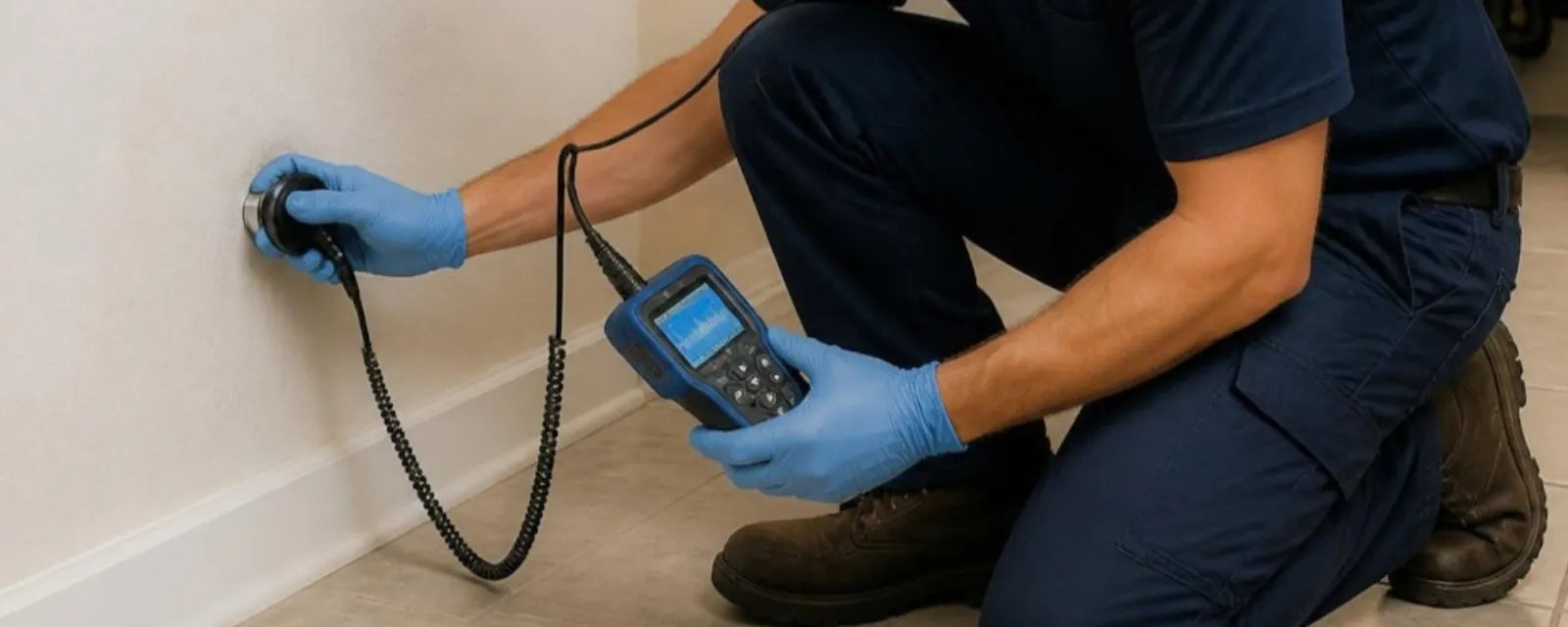
Modern tools mean a leak can often be pinpointed without cutting open more than a small section of wall.
Confirm the leak exists
A meter check or a pressure gauge on the line shows whether water is being lost.
Isolate sections
Closing valves one by one finds which part of the system is losing pressure.
Listen and scan
Acoustic sensors and thermal cameras narrow the search to a small area on the wall or floor.
Open only what is needed
Once the spot is marked, a small opening gives access for repair, and the repair is priced clearly before work starts.
Our leak detection service uses the same step-by-step approach and explains each finding before any repair begins.
Blue Island, IL: what local homeowners should know
The median home in Blue Island was built in 1961, and about 64.7% of the housing stock predates 1970. Older supply lines, aging fittings and original shutoff valves are common, which makes slow leaks more likely than they are in newer subdivisions. A leak sign in a house of that age is worth checking sooner, not later.
Chicago-area winters bring hard freezes. At O'Hare, January's average low is 18.8 degrees Fahrenheit and the area gets about 38.4 inches of snow a year. Pipes on exterior walls and in unheated spaces crack in those temperatures, so a wet wall after a cold spell may be a split pipe, not an old stain.
The Illinois Plumbing Code requires water service pipe to be buried at least 36 inches deep or below frost depth, whichever is deeper, to guard the line from freezing.
Many Blue Island buildings are multi-family: about 42.6% of the housing is multi-family, according to the county hazard plan. In a two-flat or small apartment building, a stain in your unit may come from the unit above, so talk to the owner and shut off only the lines you control. Our crews also serve Alsip and Midlothian, where the same cold-weather leak patterns apply.
Questions homeowners ask
Yes. Leaks inside walls, under slabs or beneath floors may show up first as a higher water bill, a musty smell or a drop in pressure.
A warm patch often signals a hot water line leaking beneath it. Turn off the water heater supply and call a plumber to test the line.
It can be. Mold needs moisture, and a hidden leak supplies it for weeks. Fix the source and dry the area, or the mold returns.
Sudden bursts are often covered, but slow leaks and wear usually are not. Read your policy and call your agent early.
Exterior wall pipes can freeze and split when the Chicago-area temperature drops well below freezing. The leak shows once the ice thaws.
Tell the owner or property manager. Shut off water only to the fixtures you control, and call (773) 207-0518 if the leak is inside your own unit.