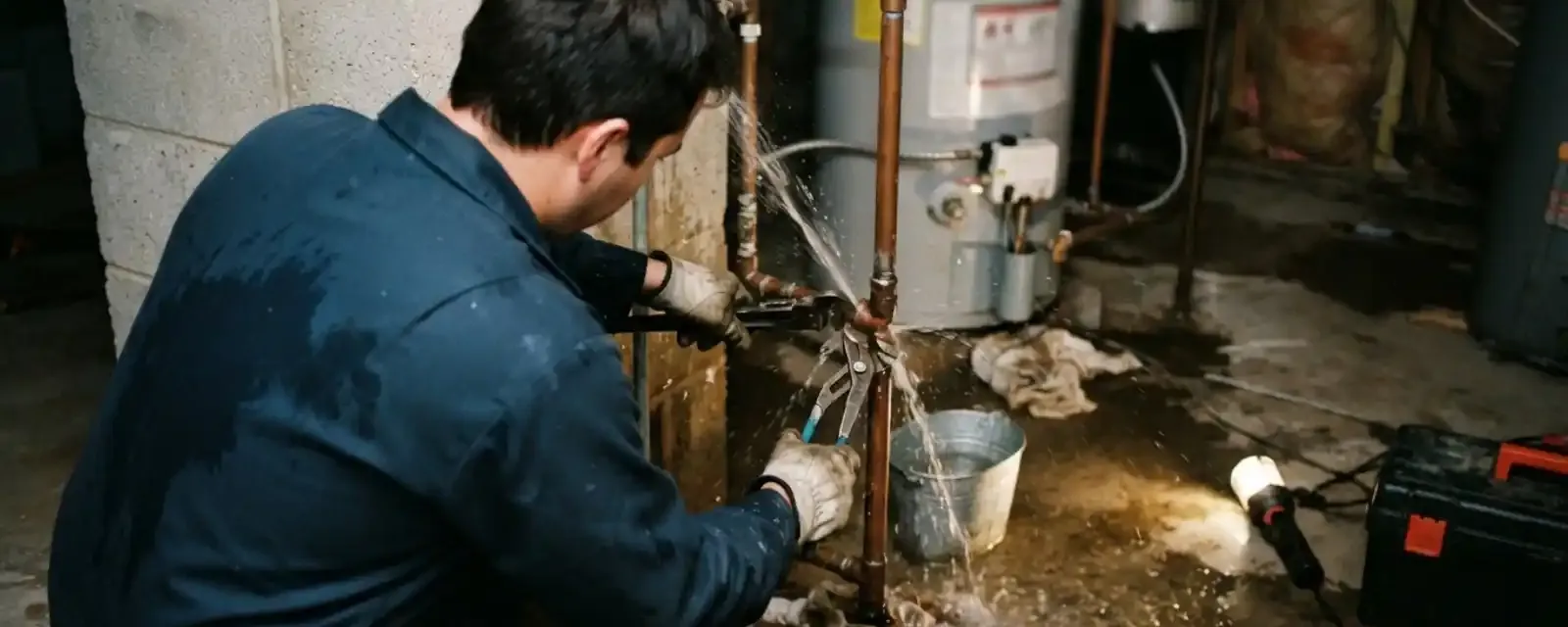
A burst pipe keeps pouring water into walls, floors and ceilings until someone closes a valve, so speed matters most. Close the main shutoff first, then call our 24/7 emergency line at (773) 207-0518 and licensed plumbers will be dispatched, with same-day visits when the schedule allows. Everything below helps you protect the house while help is on the way.
This page covers what a burst looks like, how we thaw and replace frozen sections, and what each common pipe material does when it fails. It also explains why Blue Island winters make this a real risk.
Pipe just burst: your first ten minutes
Find the main shutoff, often by the meter, and turn it fully. Then open the lowest faucet in the house to drain what is left in the lines.
Stay away from standing water near outlets, cords and the electrical panel. If the ceiling is sagging with trapped water, keep out from underneath it.
- Close the main shutoff and drain the lowest tap.
- Switch off power to wet areas only if you can reach the breaker while dry.
- Move furniture, rugs and electronics out of the water's path.
- Photograph damage before cleanup and call (773) 207-0518.
What each pipe material does when it fails
The material in your walls changes the repair. A quick look at the pipe tells us what we are dealing with.
Copper
Freeze damage shows as a lengthwise split. Corrosion shows as pinholes with green crust. Both are repaired by cutting out the damaged section and joining new copper.
Galvanized steel
Rust builds inside the pipe and weakens threaded joints. One repair often reveals more thin spots nearby, so replacement of the run is worth pricing.
Cast iron
Used mostly for drains and stacks, it cracks or corrodes through rather than bursting under pressure. Cracks show up as seepage, odor or staining below.
Plastic (PEX, CPVC, PVC)
Cracks often trace back to freezing, a bad fitting or impact. We replace the section and check the fittings around it.
Frozen pipe repair: thaw, then inspect
A frozen pipe may not have split yet. If a faucet gives only a trickle in cold weather, keep it open, close the main if you see any wet spot, and call (773) 207-0518. Do not use an open flame on a pipe.
Chicago-area (O'Hare) normals show January averaging a low of 18.8 F and February 21.8 F, with about 38.4 inches of snow a year. Those temperatures put unheated crawlspaces, garages and exterior-wall runs at risk.
We thaw the pipe slowly, then check joints and the pipe wall for splits before the water goes back on. The ice often hides the break, and the leak starts only as it melts.
Water is moving. We can be too.
Shut off the main, then call (773) 207-0518. Licensed plumbers are on the 24/7 line.
Patch, section replacement or a full run
Not every burst needs the same fix. This table shows how we weigh the options with you.
| Option | Best when | Trade-off |
|---|---|---|
| Clamp or temporary patch | You need water back overnight | Short-term only, plan a proper repair |
| Cut-out and new section | Damage is isolated, pipe is sound | Quick, but nearby old pipe may fail later |
| Replace the whole run | Pipe is corroded or splitting repeatedly | Higher cost now, fewer repeat calls |
| Reroute through open space | Pipe sits in a finished wall or slab | Less demolition, but exposed pipe must be protected |
How an after-hours burst repair runs
The process is the same at 2 a.m. or at noon.
Phone triage
You describe the shutoff, the pipe and the water. We tell you what to do before we arrive.
Isolate and assess
On site we shut off the line, find the full length of damage and check pipe material.
Price confirmed
You hear the options and a clear price before work starts.
Repair and pressure test
We replace the pipe, then pressurize it and watch for any drop before closing anything up.
Water damage restoration, such as drying and drywall, is separate work. Ask us what we saw so your insurer has the facts.
Why Blue Island pipes fail in winter
About 64.7% of Blue Island homes were built before 1970, with a median build year of 1961. Older pipe walls are often thinner from corrosion, so a hard freeze finds the weak spot.
The Illinois Plumbing Code (77 Ill. Adm. Code 890.1150) requires the water service pipe to be buried at least 36 inches, or at frost depth if deeper. A service line shallower than that is a freeze risk, so tell us if your line was ever repaired or relocated.
The Illinois Plumbing Code (77 Ill. Adm. Code 890.1150) requires exterior-wall pipe to be protected from freezing. A split pipe on a cold wall suggests that protection failed or never existed. Ask us to check the whole run when we repair it, so the same wall does not burst again.
What shapes the cost of burst pipe repair
We quote the repair after we see the damage. These are the factors that move the number.
Insurance: sudden bursts are the usual covered case under homeowner policies, while slow leaks and wear often are not. Read your policy and report promptly.
Want your real number? Call (773) 207-0518 and we will talk it through.
After the repair: protect the house
The pipe is only half the job. Water left in walls causes problems for weeks.
- Run fans and open cabinet doors to dry the area quickly.
- Check ceilings below for stains over the next few days.
- Insulate exposed pipes on exterior walls and in unheated spaces.
- If the leak was not a burst, see leak detection for a hidden source.
- If the burst was on the line from the street, see water service line repair.
Burst and frozen pipe questions
Yes. Our emergency line, (773) 207-0518, is answered around the clock, including nights, weekends and holidays. Same-day visits are available when the schedule allows.
Keep the faucet open and warm the room gently. Do not use a flame. Call (773) 207-0518 if water stops flowing or you see any wet spot.
Often we can reach it through a small opening, or reroute through an open basement ceiling. We explain the choices and the price first.
Old galvanized tends to corrode from inside, so it leaks at thin spots or joints rather than splitting. Frozen copper usually splits lengthwise.
Sudden bursts are often covered, but gradual leaks and wear may not be. Check the policy and photograph the damage.
Do not wait. Shut off the main and call right away, because wet drywall and framing keep absorbing water the longer it runs.