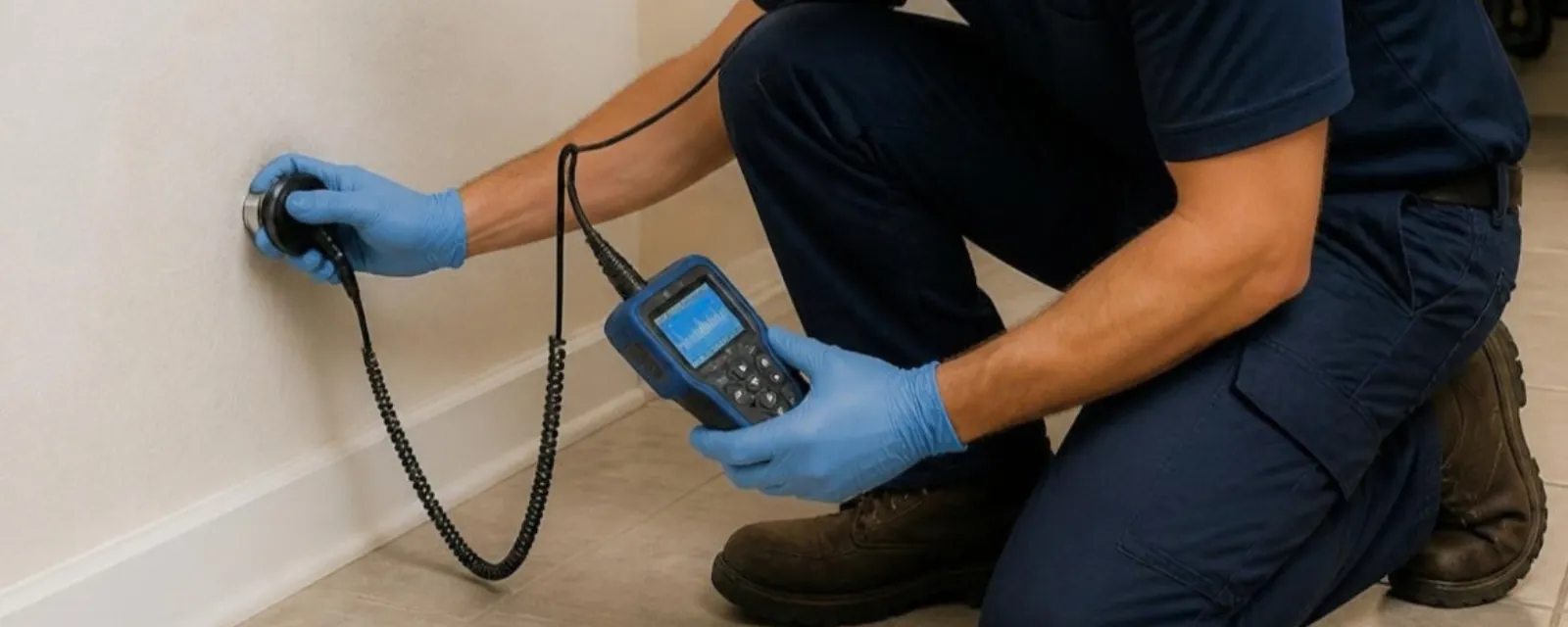
Emergency leak detection starts with one question: where is the water going? A meter that keeps turning with every fixture off, a stain spreading across a ceiling, or a floor that feels warm underfoot all point to a pipe that is failing out of sight. Our 24/7 emergency line, (773) 207-0518, is staffed around the clock, and licensed plumbers can often come the same day when the schedule allows.
We find the leak first and open the wall second. That order saves drywall, tile and money. If the water is active right now, read the next section before you pick up a mop.
Water is actively leaking: what to do right now
Shut off the main valve, usually near the meter or where the line enters the basement. Then open one low faucet to drain pressure from the pipes. If water is near outlets, a light fixture or the panel, stay out of the room and switch off power only from a dry spot.
Move valuables, lift rugs and photograph the damage for your records. Then call (773) 207-0518 and tell us what you see, so we can arrive with the right equipment.
- Close the main shutoff and confirm the meter dial has stopped.
- Keep off wet floors near electrical outlets and appliances.
- Place a bucket under a dripping ceiling and poke a small hole only if the drywall is bulging with water.
- Note when you first saw the stain and whether it grows when water is running.
Meter still running or the bill creeping up
Many leak calls begin with a number, not a puddle. Shut off every tap and appliance, then watch the meter's small leak indicator or low-flow dial. If it keeps moving, water is escaping somewhere between the meter and your fixtures.
In Blue Island the city reads residential meters every other month and bills monthly, so a leak can run for a while before a bill makes it obvious. Compare two readings a day apart, and ask the Blue Island Water and Sewer Department about its High Water Usage Checklist.
If the dial moves with the main shutoff closed inside the house, the leak is likely on the buried line before the shutoff. That points to water service line repair rather than a wall repair.
Signs of a leak you cannot see
Not every leak drips. Most announce themselves quietly, and the clues below are the ones callers describe most often.
- A stain or bubble on a ceiling or wall. A supply or drain line above is weeping, often near a bathroom or kitchen.
- A warm spot on the floor. A hot-water line under the slab can heat the concrete above it.
- The sound of running water at night. A hiss or trickle with everything off means a pressurized line is losing water.
- Musty smell or peeling paint. Moisture inside a wall cavity feeds mold and lifts finishes long before it drips.
- Lower water pressure than usual. Escaping water means less reaches the shower.
- Soft or sunken ground in the yard. A leak on the line from the street can saturate soil over the pipe.
Meter running? Let us listen.
Describe what you see and we will tell you which test to start with. Call (773) 207-0518 any hour, day or night.
Symptom to likely source
The table shows where we usually start looking. A symptom narrows the search but never replaces a test.
| What you notice | Likely location | First test |
|---|---|---|
| Meter moves, all fixtures off | Buried service line or hidden branch | Meter test, then acoustic listening |
| Stain on ceiling | Supply or drain line above, or a fixture seal | Moisture meter and thermal scan |
| Warm floor | Hot-water line in or under slab | Thermal imaging, then acoustic |
| Damp crawlspace or basement wall | Joint or line in the joists, or outside water | Visual survey and pressure test |
| Wet patch in yard | Line from the street to the house | Pressure test and ground microphone |
How we find it without tearing things apart
Each method answers a different question, and honest leak work uses more than one. No single gadget finds every leak.
Meter test
We isolate the house, read the meter, and wait. Movement proves a leak exists and tells us if it sits before or after the main shutoff.
Acoustic listening
Sensitive microphones on floors, walls and pipe ends pick up the hiss of pressurized water. Quiet plastic and large pipes are harder to hear.
Thermal imaging
An infrared camera shows temperature differences from wet material or a hot line, which helps on ceilings, walls and slabs.
Pressure test
We close off a section, pressurize it and watch the gauge. A steady drop confirms that run is leaking and lets us work section by section.
Once the source is marked, you get a clear price before work starts and a choice between spot repair and replacing the run.
Where leaks hide in older homes
Housing age shapes the search. About 64.7% of Blue Island homes were built before 1970, and the median build year is 1961, so many houses carry original piping that has had decades to corrode.
Slab and under-floor lines
Common in slab-on-grade houses. A warm patch or a constant hiss usually leads us here, and rerouting overhead is often cheaper than breaking concrete.
Crawlspace and basement joists
Joints and old galvanized lines drip where you cannot see. A visual survey with a moisture meter often settles it fast.
Buried lines and irrigation
Leaks between meter and house, or in a sprinkler zone, show as soft ground. Ground microphones trace them.
Walls and ceilings in multi-unit buildings
About one in four Blue Island housing units sits in a building of 5 to 19 units, and a stain in one apartment may start in another.
Water that is not from a pipe
Blue Island is largely served by a combined sewer system, and heavy rain has flooded low spots such as the area around Washington Street and Vermont Street near California. A wet basement after a storm is therefore not always a leaking supply pipe.
A meter test separates the two cases quickly: if the dial is still after a storm, the water came from outside or the drain side. That keeps you from paying for pipe repair you do not need, and sends you toward sump pump service or sewer work instead.
Each main building gets its own water service pipe under Blue Island code section 52.009, so a leak hunt can start at your own meter. The Illinois Plumbing Code (77 Ill. Adm. Code 890.1150) puts service pipe at least 36 inches down or below frost depth. A yard leak therefore means digging, and an 811 call comes first.
What drives the price of finding and fixing a leak
Locating a leak and repairing it are separate jobs. We quote the search first, then the repair once we know what it takes.
On insurance: sudden, accidental damage such as a burst is the usual covered case. Gradual leaks and wear are often excluded unless you hold a specific endorsement, so read your policy before you file.
Want your real number? Call (773) 207-0518 and we will talk through the job before anyone is dispatched.
Leak detection questions from Blue Island homeowners
Turn off every fixture and appliance, then watch the leak indicator or low-flow dial on your meter. If it moves, water is escaping. Take a reading, wait an hour with no use, and read again to confirm.
Yes. Our 24/7 emergency line, (773) 207-0518, is answered around the clock, and same-day or after-hours visits are available when the schedule allows. Shut off the main valve while you wait and keep clear of wet electrical areas.
Often, yes. Thermal imaging and acoustic gear narrow the location, and a pressure test confirms which line is failing. We then discuss repair in place or rerouting the line overhead.
Not as a first step. We test and mark the likely source, then open the smallest section needed. You see the plan and the price before work starts.
Not always. Blue Island's combined sewers and low-lying areas can send water in from outside, so a meter test helps tell supply leaks from storm or drain problems.
Some policies cover finding the source of a sudden covered loss, and many treat slow leaks as maintenance. Ask your insurer before the visit and keep photos.