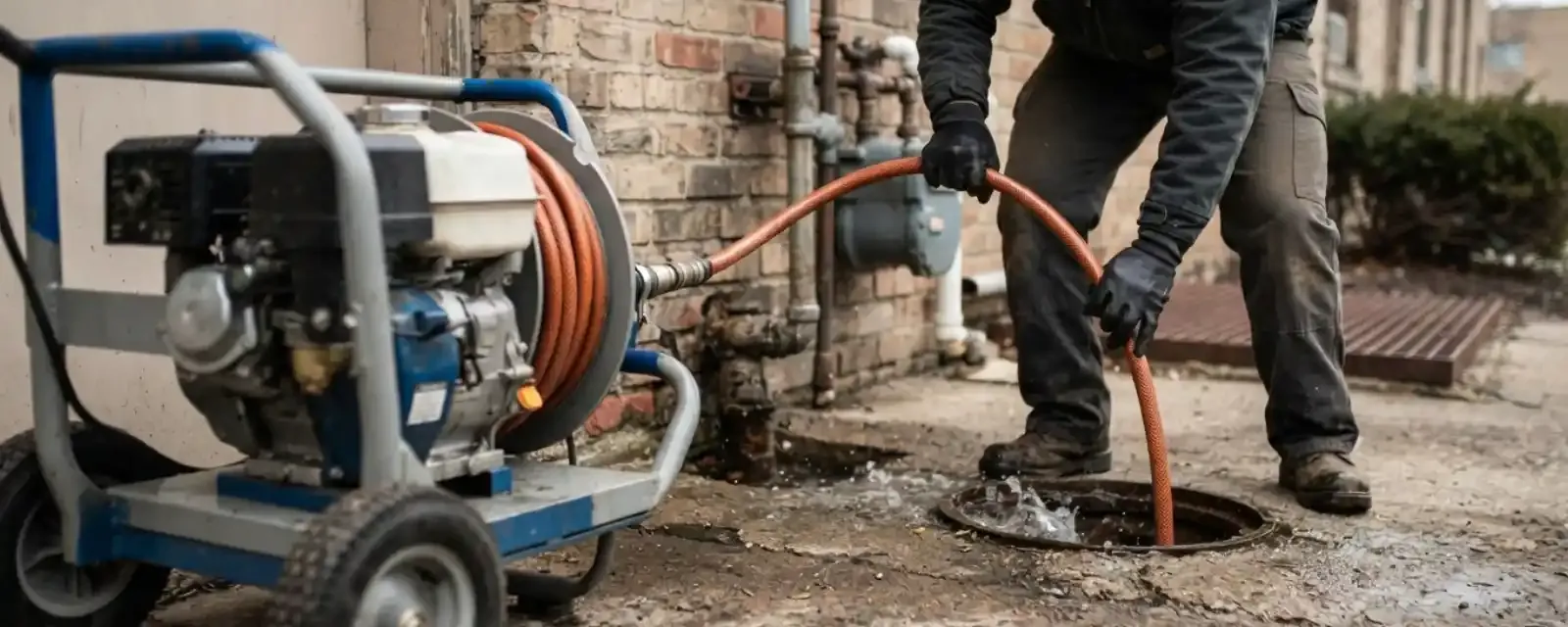
Hydro jetting sends pressurized water through a hose and out a rotating nozzle, scouring grease, silt and scale off the whole pipe wall. It is the job we reach for when a line backs up again a few weeks after snaking. If your drain is flooding now, call (773) 207-0518. The 24/7 emergency line is staffed around the clock, and a licensed plumber will tell you what to shut off first.
A cable punches a hole through a clog. A jet washes the pipe itself, which is why the result lasts longer. It is not right for every pipe, though, so we look first and jet second.
Why a cable leaves the job half done
Picture a pipe lined with a quarter inch of grease. A cable spins a hole through the middle, water drains, and you think the problem is solved. The coating stays, and new debris catches on it within weeks.
A jetting nozzle has jets that point backward, and the thrust pulls the hose down the line while a forward spray breaks up the blockage. Water then sweeps the loosened material out toward the main sewer. Think of it as washing a pipe instead of drilling through it.
Emergency hydro jetting: when the line has stopped completely
Call right away if sewage is coming up a floor drain, a restaurant line has stopped mid-service, or a toilet will not flush and the tub is filling. Same-day appointments are available when the schedule allows, and after-hours calls reach the 24/7 emergency line.
While you wait, treat the water as contaminated. Keep children and pets out of it and stay away from wet electrical areas.
- Stop using every fixture, including the washer and dishwasher.
- Do not touch plugged-in items in standing water, and stay clear of a wet panel or outlet.
- Take a photo of the backup for your insurer, then call (773) 207-0518.
- Tell the dispatcher if a cable has already been tried, and what happened.
Line stopped completely?
Call (773) 207-0518 now. The 24/7 line is open, and we will tell you what to shut off while a plumber is lined up.
A hydro jetting visit, start to finish
Jetting is a controlled process, and the camera comes before the nozzle.
Camera look first
A small camera on a flexible rod shows the pipe material, cracks, offset joints and where the blockage sits.
Pick the nozzle
A flat penetrator nozzle opens a stopped line. A wide-angle spinning nozzle cleans the walls. Root cutters ride a chain or blade in the stream.
Jet in passes
We push the hose in until it reaches the blockage, then work back slowly, pulling debris toward the cleanout.
Camera again
A second pass confirms the walls are clean and that no cracks were hidden by grease.
What jetting handles and what it does not
Different buildups call for different answers. Here is the honest comparison.
| Problem | Does jetting help? | What else may be needed |
|---|---|---|
| Grease and soap scale | Yes, clears the whole wall | Kitchen habit changes to stop it returning |
| Fine tree roots in joints | Yes, with a root-cutting nozzle | Re-jet on a schedule since roots regrow |
| Heavy root mass or flaking cast iron | Sometimes, after a camera review | Cable first, then possible sewer line repair |
| Cracked, offset or collapsed pipe | No, water can push into the soil | Dig or lining |
| Foreign object or toy | Sometimes | Cable retrieval or a spot dig |
Where jetting earns its keep
These are the lines where a repeat clog is most likely to need more than a cable.
Kitchen and restaurant lines
Grease and starch build faster than any other buildup. Commercial kitchens often need a scheduled jet along with a grease trap check.
Basement floor drains
Silt, lint and laundry residue collect here, and a floor drain is the first place the main line shows trouble.
Main sewer line to the street
The long run between the house and the city sewer holds grease, paper and roots. A jet clears its full length.
Apartment stacks and shared branches
In a multi-unit building, one stuck line affects every unit. See our sewer line cleaning page for how shared mains are handled.
Yard and exterior drains
Dirt and roots clog outdoor drains often. Jetting flushes soil that a cable only pushes around.
When we say no to jetting
Jetting uses real force, and an old pipe with thin walls or open joints can leak water into the soil. If the camera shows a collapsed section or a cast iron pipe flaking in layers, we will not jet it. We will tell you why and show you the footage.
The right plan might be a gentler cable, a short spot repair or a liner. Our camera inspection page explains what the footage shows.
Jetting older Blue Island pipe and buildings
About 64.7% of Blue Island housing predates 1970, and the median build year is 1961 (CMAP, 2020 to 2024 survey data). Cast iron and clay tile from that period have rough walls that hold scale. City code asks for a house sewer at least 6 inches inside, which leaves room for a jet nozzle on most lines.
Most of the city is on a combined sewer, and three overflow points reach the Calumet-Sag Channel, at Irving Avenue and Division Street (city CSO notice). A clean house line cannot stop a street sewer from surcharging in a downpour, but it does remove your own line as the cause.
If your building sits in an older storefront block near Western Avenue and the work might involve digging, ask the city Building Safety office about historic district review before any exterior work.
Blue Island code section 52.009 describes house sewers as tile or cast iron, so a camera look at the pipe's condition before high-pressure water goes through it is sensible. A repair found along the way needs a permit under section 150.052. The Illinois Plumbing Code (77 Ill. Adm. Code 890) is the state code.
What affects the price of a jetting visit
You get a clear price before work starts, and the camera lets us explain it.
Insurance usually treats jetting as maintenance and does not pay for it. Sudden burst damage is the usual covered case, while gradual leaks, wear and sewer backup often need a specific endorsement, so check the policy. Want your real number? Call (773) 207-0518.
Hydro jetting questions we hear in Blue Island
Yes. The 24/7 emergency line takes calls at any hour, and a licensed plumber is dispatched for stopped main lines and flooding floor drains. We do not promise an arrival time. We do tell you how to limit the damage until we reach you.
Often yes, but only after a camera look. Thick cast iron with scale on the inside cleans well. Pipe that flakes in layers or has open joints is not jetted, because the water can force its way out.
Snaking opens a hole through a clog. Jetting scours the entire inside wall, so grease and roots lose their foothold. If your line has clogged twice in a few months, jetting is usually the better next step.
It depends on volume and menu. Fried food and dairy build up quickly. After the first visit, we can suggest a schedule based on what the camera shows.
No. It clears the roots inside the pipe, but they regrow toward the water and nutrients. A liner or a repaired joint is the lasting fix. Until then, periodic jetting keeps the line open.
It should not. We work from a cleanout so water runs away from the house. Tell us about floor drains or a low-lying basement so we can plan the route.