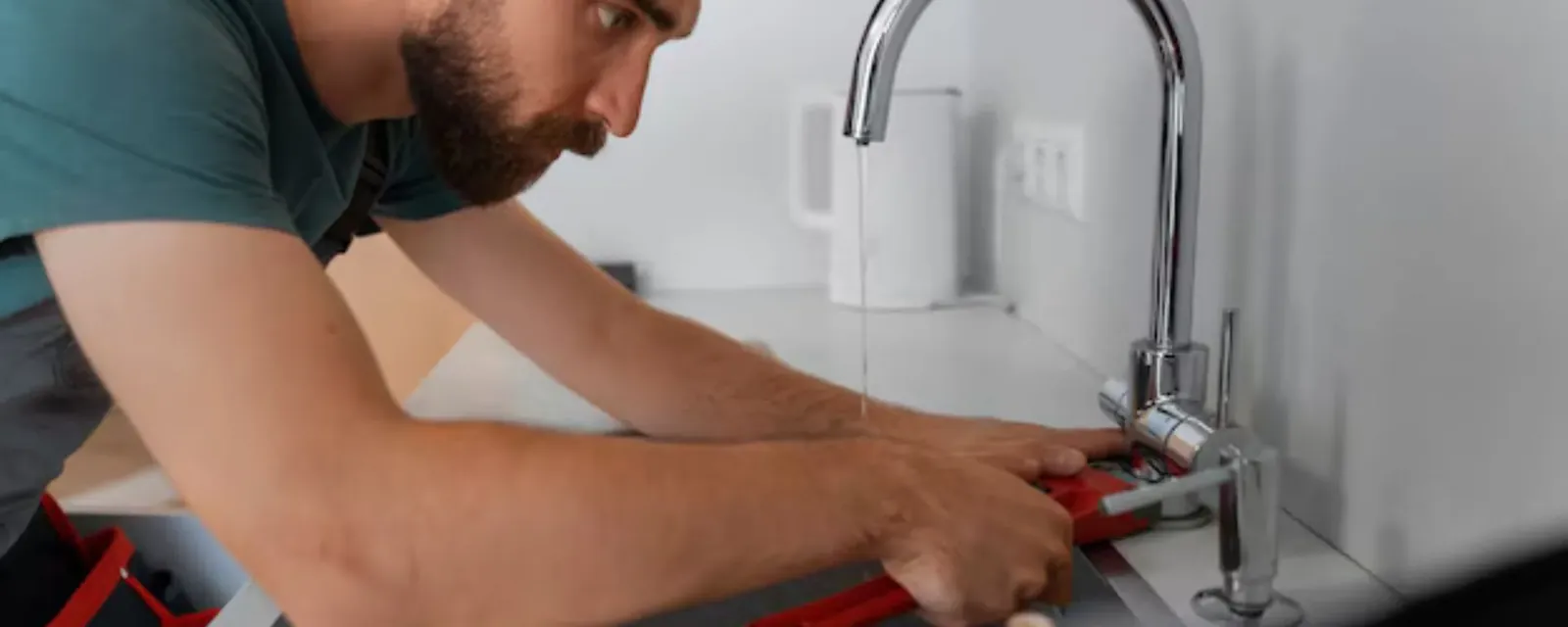
Most kitchen faucet problems in Blue Island homes come down to one worn part: a cartridge, a rubber seat, an O-ring or a clogged aerator. A steady drip from the spout means the internal seal has worn out. Weak flow usually means mineral grit in the aerator or a kinked supply line. A leak under the sink points to a loose nut or a cracked hose.
You can handle several of these in an afternoon with a basin wrench, an adjustable wrench and a hex key. Others, like a seized shutoff valve or corroded pipe behind the wall, are better left to a licensed plumber. This guide shows which is which, and what to do first so a small repair does not become a flooded cabinet.
Read the symptom before you buy a part
The way a faucet fails tells you most of what you need to know. Match what you see to the likely cause, then decide whether to open the faucet yourself.
- Drip from the spout when the handle is off. The cartridge, ceramic disc or valve seat is worn. Replacing the cartridge fixes it most of the time.
- Water at the base of the handle. A dried-out O-ring or loose packing nut lets water creep up the stem. This is usually a cheap fix.
- Weak or sputtering stream. Unscrew the aerator and look for white or gray grit. If the aerator is clean, check the supply hoses for a kink and the angle stops for a half-closed valve.
- Spray from the side of a pull-down hose. The spray head diverter or the hose connection has failed. Both are replaceable without removing the faucet.
- Wobbling faucet body. The mounting nut under the sink has loosened, or the sink deck has cracked around the hole.
- Wet cabinet floor. Dry the area, wipe each fitting with a paper towel and watch which one darkens first. That is your leak.
If the paper towel stays dry at every fitting but the cabinet is still damp, the water may be coming from the drain trap or the dishwasher line, not the faucet.
How a basic cartridge swap works
Most single-handle kitchen faucets use a replaceable cartridge. The job takes about 30 to 45 minutes once the water is off, and the part is often the only thing you need to buy. Take the old cartridge to the store so you match its shape and spline count.
Shut off the water
Close both angle stops under the sink by turning them clockwise. Open the faucet to release pressure and confirm the flow stops.
Plug the drain
A small screw or retaining clip can vanish down the sink. Stuff a rag in the drain or set the stopper first.
Remove the handle
Pry off the cap, back out the set screw with a hex key and lift the handle straight off. Take a phone photo of every layer as you go.
Pull the old cartridge
Unscrew the retaining nut or pull the clip, then lift the cartridge out. Wipe the brass body clean of grit.
Seat the new one and test
Align the notch, tighten the nut by hand plus a quarter turn, then open the stops slowly and run the faucet for a minute while you watch for seepage.
Older two-handle faucets with compression stems work differently. They use a rubber washer and a brass seat, and the seat itself can be pitted. A pitted seat needs a seat wrench or a new faucet, and that is a good point to call a plumber.
Do it yourself or call a plumber
Cost and risk both rise when the problem sits behind the faucet instead of in it. Use this table to decide where your repair falls.
| Problem | Usual cause | Who handles it |
|---|---|---|
| Drip at the spout | Worn cartridge or seat | Most homeowners with basic tools |
| Weak flow | Clogged aerator | Homeowner, takes about 10 minutes |
| Angle stop will not close or drips when turned | Old packing or corroded stem | Plumber, because forcing it can break the valve |
| Leak at the supply line nut | Cracked braided hose or worn washer | Homeowner if the stop closes, plumber if not |
| Pipe stub behind the wall leaks or is corroded | Age of the supply piping | Licensed plumber |
| Low pressure at every fixture | Whole-house issue, not the faucet | Plumber |
The angle stop row matters most. A stop that will not close means you cannot isolate the faucet, so the only safe shutoff is the main valve. If water keeps showing up and you cannot trace it to a fitting, leak detection can find a hidden source behind the cabinet.
Stuck stop valve or a leak you cannot trace?
Call (773) 207-0518 and tell the dispatcher what you see. Same-day appointments are available when the schedule allows, and the 24/7 line is open if water is spreading.
Find your shutoffs before anything drips
Every repair above starts with knowing where the water stops. The valves under the sink isolate only that faucet. The main shutoff controls the whole house, and you should be able to reach it in under a minute.
In an older Blue Island house the main valve is usually in the basement near the meter, on the wall where the service pipe enters.
Turn it a full quarter or several rotations depending on the valve type, then open a faucet at the lowest point to confirm the flow has stopped. If a main shutoff is stuck or leaks around the handle, a plumber can replace it with a ball valve that works every time.
The Illinois Plumbing License Law (225 ILCS 320) is the state's licensing rule for plumbers. Blue Island code section 150.052 lets an owner-occupant of a single-family home apply for a permit, so a DIY faucet swap in your own house is a different case from hiring someone. If you hire, check the licence.
When a repair is really a replacement
A faucet that is 15 or 20 years old may cost more to repair than to replace. Watch for these signs before you spend an afternoon on parts.
Parts are discontinued
If the manufacturer no longer sells your cartridge, a universal part often leaks again within months.
Finish is flaking or pitted
Corrosion on the body means the metal itself is failing, and no seal will fix that.
The faucet leaks in two places
Two failures at once usually mean the valve body is worn. Replacing the whole unit is cleaner.
The sink deck is cracked
A cracked mounting hole cannot hold a new faucet firmly and may need a plumber and a countertop fix.
Aerators, grit and your tap water
A clogged aerator is the cheapest fix on this page. Unscrew the tip of the spout, rinse the screen under running water and use an old toothbrush on the mesh. A vinegar soak for an hour loosens the crusty deposits that build up around the holes.
If the screen clogs again within weeks, mineral content in your water could be the cause, or loose scale from old pipes upstream. Blue Island does not publish a hardness figure in its 2025 water quality report, so a cheap test strip from a hardware store is the practical way to find out what is coming out of your tap.
What a plumber adds that a parts store does not
A licensed plumber can pull a seized stop, replace corroded supply stubs and test the system under pressure. That matters when a stop will not close and the only way to stop a drip is to shut off the whole house. The same kind of call comes up in neighboring Alsip, which shares a boundary with Blue Island, and in Riverdale to the southeast.
Our faucet repair visits start with the clear price before work starts, so you know the cost before a tool comes out. If the leak is more than a drip, call (773) 207-0518 and we can talk through what to shut off while a plumber is on the way.
Blue Island, IL: what local homeowners should know
Blue Island buys its water from the City of Chicago, and the city's Water and Sewer Department at 13051 Greenwood Avenue handles billing and service questions. For a faucet, that means supply pressure and water quality are set upstream of your house. The city's 2025 report does not list hardness, so test your tap instead of guessing before you blame the faucet for scale.
About 64.7% of Blue Island housing was built before 1970, and the median build year is 1961. In houses that age, the angle stops under the sink have often not been turned in decades, which is why they seize or leak when you finally try them. Check them now and replace any that are stiff.
Blue Island code also calls for each main building to have its own water shutoff just ahead of the meter. Find that valve before a repair starts. It is your backup if a stop under the sink will not close.
Questions homeowners ask
A worn cartridge, ceramic disc or rubber seat is letting water pass when the handle is closed. On single-handle models, replacing the cartridge fixes it in most cases. On two-handle faucets, the washer or seat is the likely culprit.
Yes, if the angle stops under the sink close fully. Turn them clockwise, open the faucet to confirm the flow stops, and you can work without touching the main valve. If a stop will not close, use the main shutoff.
Repair when the faucet is fairly new and parts are available. Replace when it leaks in two places, the finish is pitted or the model is discontinued. A plumber can look at it and give you a clear price for either path.
The city does not publish a hardness number in its 2025 report, so there is no local figure to quote. Clean the aerator and watch how fast white grit returns. A hardware store test strip gives you a real reading for your own tap.
Use the main shutoff, usually in the basement near the water meter. Blue Island code calls for a shutoff just ahead of each main building's meter, so there should be one near where the service pipe enters. If that valve is stuck too, call (773) 207-0518 and a plumber can replace it.
Yes. The 24/7 emergency line is open around the clock for active leaks. While you wait, close the angle stops or the main shutoff, move items out of the cabinet and keep clear of any outlets near the wet area.