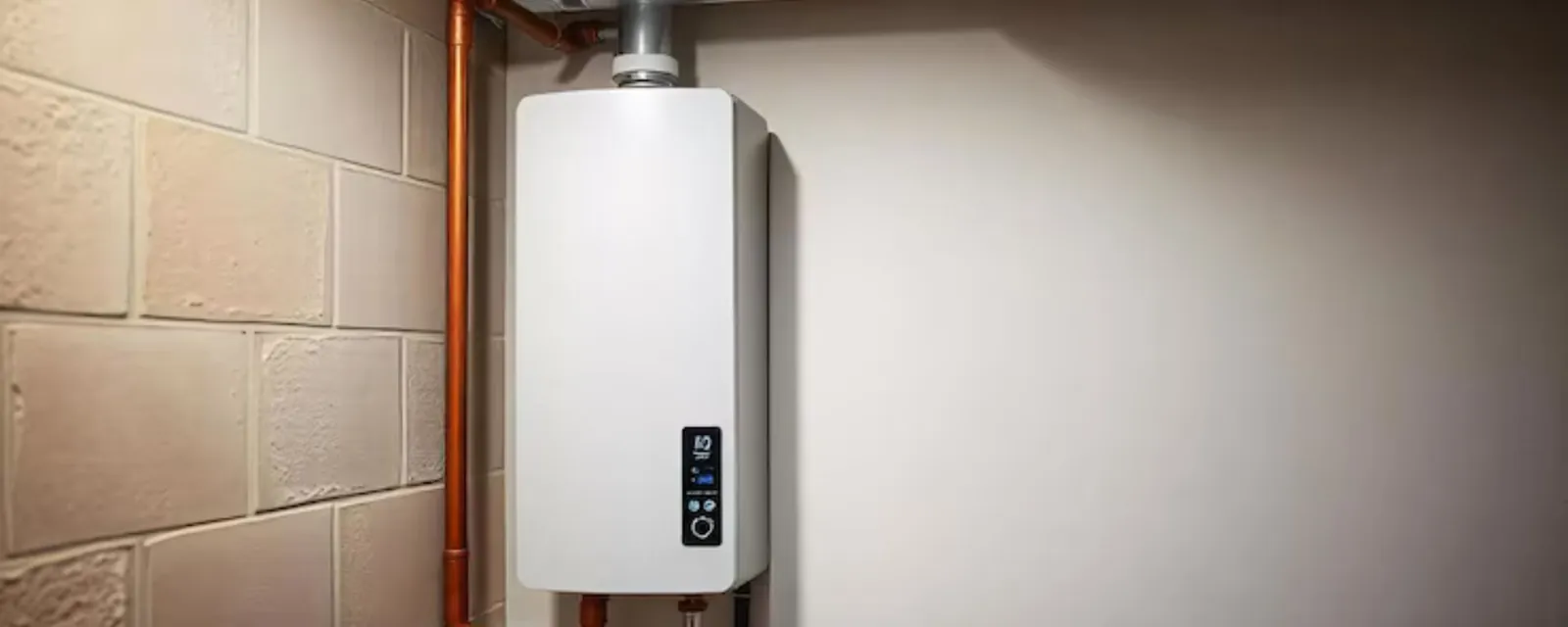
A tankless water heater warms water only while a tap runs, so there is no tank to leak and no standing reserve to run out. That also means the unit lives or dies by flow rate, gas supply, venting and mineral buildup. Licensed plumbers install, repair and descale tankless heaters in Blue Island, with a clear price before work starts. Call (773) 207-0518 to talk through your house.
Callers often tell us about a unit that cannot keep up, throws an error code, or leaks around the cabinet. Others just want to swap a tank for an on-demand model. Both are covered below.
How a tankless heater works, and who it suits
When you open a hot tap, a flow sensor tells the unit to fire or energize. Water passes through a heat exchanger and leaves at the set temperature. Stop the flow, and the unit shuts off.
The limit is the flow rate at a given temperature rise. In January the Chicago area averages a low of 18.8 F at O'Hare (NWS 1991 to 2020 normals), and the incoming water is cold as well. That larger rise means a unit rated for a certain flow in summer delivers less in winter.
Tankless suits households that value space and steady hot water. It suits a house with several people less well than a home with two showers that rarely overlap, unless the unit is sized for peak demand.
Gas, condensing and electric models: what each one needs
The type you pick sets the infrastructure you have to supply.
| Type | What it needs | Watch for |
|---|---|---|
| Non-condensing gas | Larger gas supply, stainless or special vent, power outlet | Hot exhaust and the cost of venting through the wall |
| Condensing gas | Gas, plastic vent pipe and a condensate drain | Drain routing and freeze protection on the condensate line |
| Electric | Heavy dedicated circuits and panel capacity | Panel upgrades in older houses |
| Point-of-use mini | A nearby outlet and a short plumbing run | Only serves one sink or shower |
Installing a tankless unit, in sequence
This is more involved than a tank swap, which is why we walk the house first.
Load and flow calculation
We total the fixtures that can run together and compare them with the unit's rated flow at your winter water temperature.
Gas, power and vent plan
We size the gas pipe, check the panel and choose the vent path and termination point.
Mount and connect
The unit mounts on the wall. Isolation valves go on both water lines so it can be flushed later, and a condensate drain is installed where required.
Test and teach
We fire the unit, check combustion, test temperature at several fixtures and show you the controls and the error code display.
Thinking about going tankless?
Call (773) 207-0518 and a licensed plumber will talk through flow, gas supply and venting for your home.
Older houses, gas lines and exterior vent terminations
About 64.7% of Blue Island housing was built before 1970. In those homes, the gas pipe serving the old tank may be too small for a tankless burner, so replacing a stretch of pipe can be part of the job.
Exterior vents also matter. The city requires a Certificate of Appropriateness for permits on landmarked buildings and in the Olde Western Avenue Historic District, so if your building sits in or near it, call Building Safety at City Hall, 13051 Greenwood Avenue, before choosing a side-wall vent location.
Tankless repair: what usually goes wrong
Most service calls fall into a few categories, and the display code usually points to one.
Error codes
Codes can indicate ignition, flame sensing, exhaust or temperature faults. Write the code down before you reset the unit.
Cold-water sandwich
A burst of cold water between two hot ones usually relates to short, repeated draws or a sensor issue.
Low flow
A clogged inlet filter screen or scale in the heat exchanger cuts flow and triggers shutdowns.
Leaks
Leaks at connections or the cabinet may be a fitting, or the heat exchanger. We find the source before we recommend replacement.
Service depends on the model and parts access. Tell us the make and model when you call so we know what to bring.
Flushing and descaling the heat exchanger
Minerals in the water slowly coat the inside of the heat exchanger, and a coated exchanger heats less efficiently and runs hotter. A flush removes that scale before it hardens.
The process uses the isolation valves. We close the water, connect a small pump and hoses, and circulate a descaling solution through the unit, then rinse it clean. We also clean the inlet filter screen.
Blue Island buys Lake Michigan water from Chicago, but the city's published water reports do not list a hardness figure. Test your tap with a hardness strip or ask the Blue Island Water and Sewer Department. Then follow the manufacturer's flushing interval for your unit, and shorten it if the water proves hard.
Every tankless unit ships with manufacturer installation instructions covering venting, gas line size and clearances, and the install follows them along with the Illinois Plumbing Code (77 Ill. Adm. Code 890). Whether a heater swap needs a city permit is a question for Building Safety, so ask before the install date.
Signs a tankless unit needs attention
Catch these early and you may only need a flush.
- Hot water takes longer to arrive than it used to.
- The temperature swings or turns lukewarm at high flow.
- An error code returns after you reset the unit.
- You hear rumbling or kettle-like noise while it runs.
- Water or rust shows at the isolation valves or cabinet.
- The unit has never been flushed since it was installed.
What drives tankless pricing for install, repair or flush
Tankless work varies more than tank work. You get a clear price before work starts, whichever job you need.
Insurance rarely pays for descaling or planned upgrades. Sudden leaks that flood a room may be covered, but gradual leaks, wear and sewer backup often need a specific endorsement. Want your real number? Call (773) 207-0518.
Tankless water heater questions from local homeowners
Usually, but the gas pipe, the venting path and the panel are the common sticking points. A walkthrough tells you what your house needs before you commit.
Follow the manufacturer's interval, and shorten it if your water is hard. Test your tap with a hardness strip or ask the Blue Island Water and Sewer Department, since the city's reports do not give a number.
Codes point to a category such as ignition, flame sensing, exhaust or temperature. Note the code before resetting, and call so we can match it to your model.
Yes. We calculate load, check the gas line and plan the vent. You may also want to read about planned water heater installation for other unit types.
Many problems are repairable, such as clogged screens, scale, sensors and igniters. A leaking heat exchanger may point toward replacement, and we explain the numbers first.
Tankless installs and flushes are planned work. If a unit is leaking or you smell gas, shut off the water and fuel, leave the building if there is a gas smell, and call the 24/7 line at (773) 207-0518. For a tank that has failed, see water heater replacement.