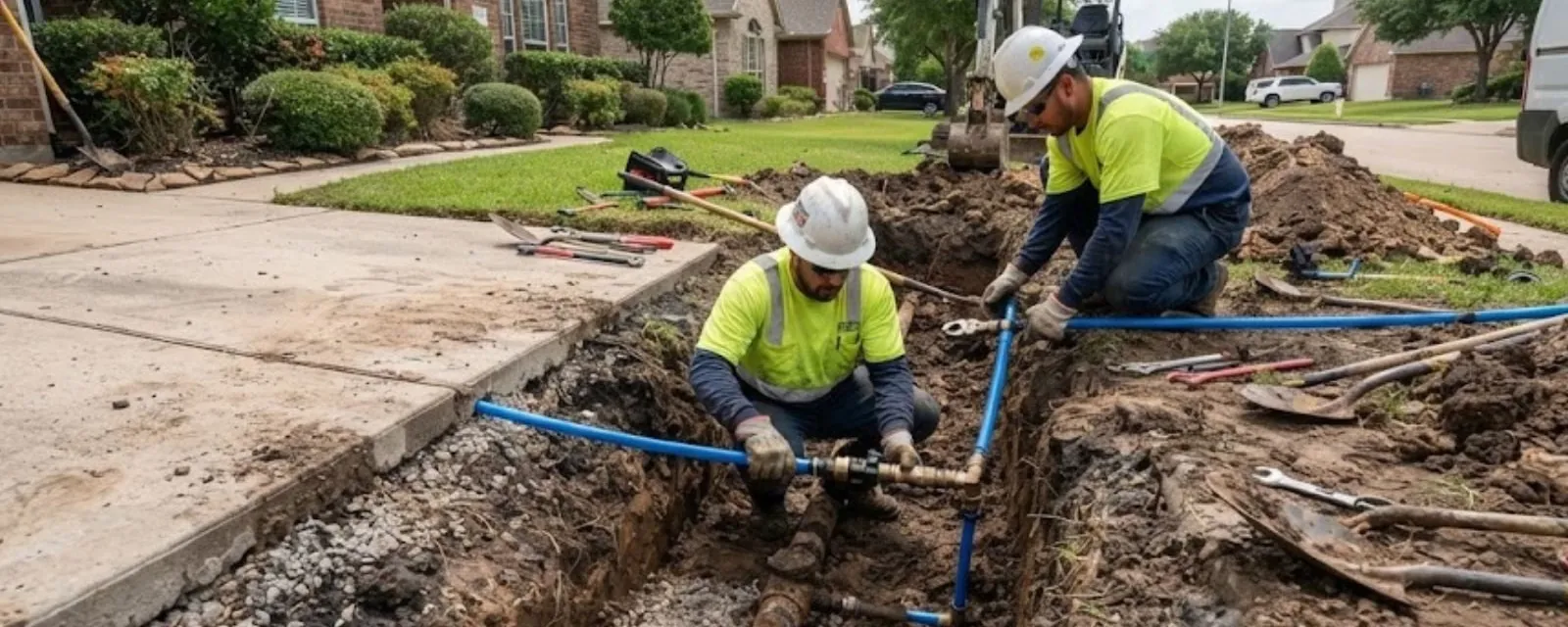
The water service line is the single pipe that carries city water from the main under the street to your meter and shutoff. When it leaks or breaks, the whole house loses pressure and the yard may flood. If water is surfacing or the meter will not stop, call our 24/7 emergency line at (773) 207-0518 and licensed plumbers can be dispatched, often the same day when the schedule allows.
This page explains how we diagnose a failing line, how repair differs from replacement, and what Blue Island owners should know about lead and galvanized lines.
Signs the line outside is failing
You usually notice the effects inside the house first. These are the patterns that point to the service line.
Pressure drops everywhere
If every faucet weakens at once, the problem is likely upstream of your branches.
Meter moves with the house off
Close every fixture. A spinning dial with the main shutoff closed inside points outside the home.
Wet or sunken ground
Soft patches, bubbling lawn or a pool of water between curb and foundation.
Dirty or sputtering water
Air or sediment entering through a failing joint or corroded pipe.
No water at all
A full break, a frozen line, or a failed shutoff valve.
Burst or leaking service line, no water at the tap, or water pooling in the yard
If a geyser or pool forms in the yard, close the shutoff valve inside the house, just ahead of the meter. Blue Island code requires a shutoff there, so you should be able to find it.
Keep children and pets away from soft ground that may be undermined. Then call (773) 207-0518. After-hours and same-day dispatch are available when the schedule allows.
- Close the valve ahead of the meter inside the house.
- Open one tap to relieve pressure and confirm the flow has stopped.
- Do not dig yourself. Buried gas, electric and water lines cross yards.
- If there is no inside shutoff or it will not turn, tell the dispatcher.
Lead and galvanized lines: what Blue Island has on record
Under the Illinois Lead Service Line Replacement and Notification Act, Blue Island published a service line inventory dated April 1, 2025. It lists 5,433 lines in total, 529 known lead, 81 galvanized requiring replacement, and 4,707 of unknown material.
That last number matters most for you. The material of your own line may simply not be known yet, so a visual check where the line enters your basement is the real answer. The city announced a program to identify materials, so ask the Blue Island Water and Sewer Department about it.
If we expose your line during a repair, we can tell you what it is made of. Ask the city whether a replacement program covers your street, and do not wait for one if your line is failing.
Water coming up where it should not?
Close the shutoff, then call (773) 207-0518. We answer around the clock.
Repair or replace the line
Both choices are legitimate. The right one depends on the pipe and the break.
| Approach | Fits when | Trade-off |
|---|---|---|
| Spot repair | One clean break in sound pipe | Cheapest now, nearby old pipe may fail next |
| Open-trench replacement | Line is lead, galvanized or repeatedly leaking | Digs up the yard, simplest to inspect and connect |
| Trenchless replacement | Landscaping, drive or walks are in the way | Less surface damage, depends on soil and layout |
| Replace inside valve and meter connection | Failure is at the entry point | Small job if the pipe itself is sound |
From locate to water back on
Digging comes last, and a lot of paperwork and marking comes before it.
Locate and confirm
We trace the line, test pressure and mark the likely break so the hole is small.
Call JULIE (811)
The excavator must request a locate ticket before digging. JULIE requires 2 days notice, not counting weekends, and marks lines on the property.
Permit and connection
Blue Island code calls for a plumbing permit and for the permit to go to the Water and Sewer Department before work.
Dig, replace, inspect
We expose the line, replace it, and call the plumbing inspector before the pipe is covered.
Restore water
Final tap and water start follow compliance. Then we backfill and flush the line.
How deep the line should sit
The Illinois Plumbing Code, 77 Ill. Adm. Code 890.1150, requires a water service pipe to be at least 36 inches deep or below local frost depth, whichever is greater. Pipe through an exterior wall must be protected from freezing.
That depth matters on a replacement. A new line set shallow is a winter failure waiting to happen. Chicago-area (O'Hare) January lows average 18.8 F, so we dig to depth and insulate wall entries rather than shortcut.
Trenching for a water service repair means calling 811 first, since the excavator files the JULIE ticket and not the homeowner. Blue Island code section 52.009 gives each main building its own service pipe, tap and meter. Confirm with the Water and Sewer Department who handles the tap before the trench opens.
What drives the cost of a water line job
A line near the curb is a different job than a long run across a deep front yard.
On insurance: sudden damage may be covered, but many policies exclude underground service line failure from wear unless you carry an added endorsement. Ask your insurer.
Want your real number? Call (773) 207-0518 for a clear price before work starts.
Water service line questions
Yes. Call (773) 207-0518 any hour. Same-day and after-hours visits are available when the schedule allows, and you can slow the damage by closing the shutoff inside.
Look where the line enters your basement or utility closet, or have a plumber identify it. The city offered free in-home identification in August 2026, so ask Water and Sewer whether it is still available.
JULIE says the excavator must make the call, not the homeowner. We handle the ticket before we dig.
That depends on where your line connects. Ask the Blue Island Water and Sewer Department where the city's responsibility ends before we price a repair.
Sometimes. Trenchless methods can reduce digging, but soil, depth and the existing pipe decide if they fit.
A main issue and a service line leak feel alike. Check whether neighbors are affected, then test your meter with fixtures off.