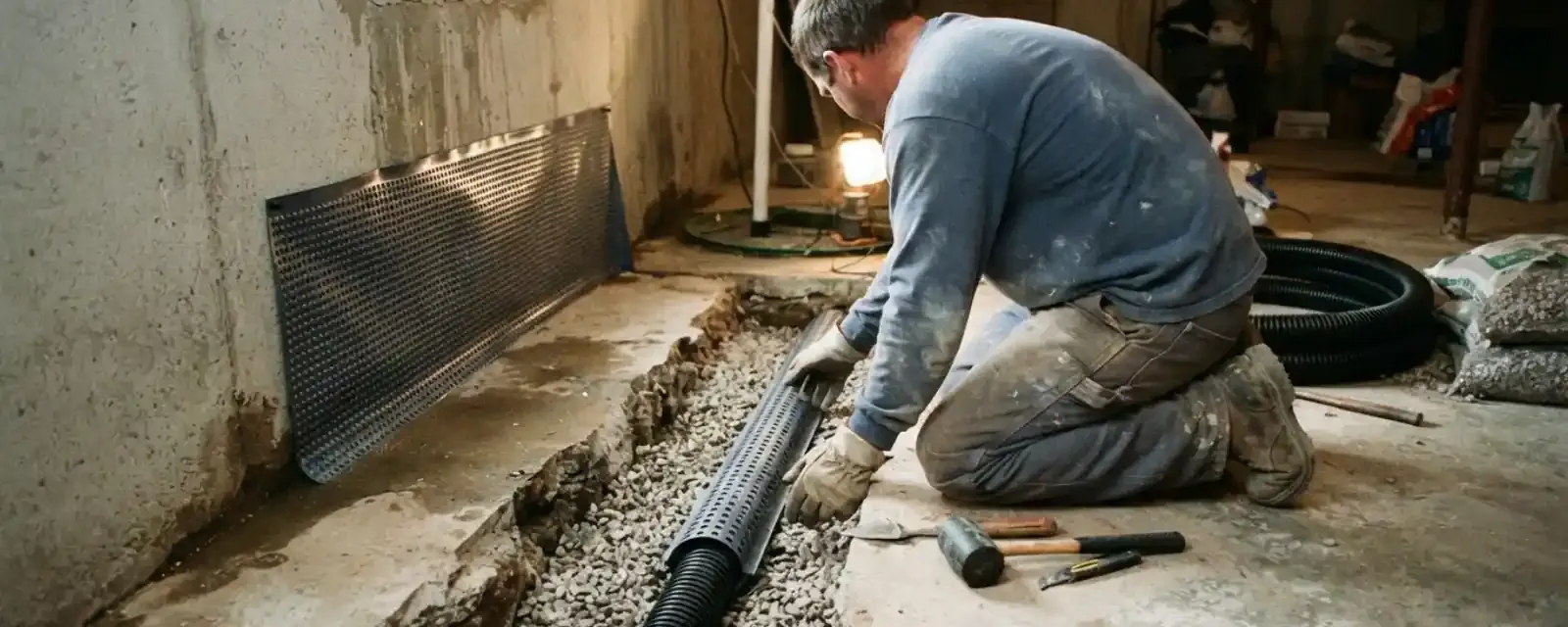
Basement waterproofing repair works by giving water a planned path out of the house instead of letting it push through the wall or floor. The three main routes are interior drain tile that carries water to a sump pump, exterior excavation and membrane work on the foundation, and crack repair for a single point of entry. Which one fits depends on where your water enters and how often it shows up.
In Blue Island, water in the basement has two common sources that look alike but are not the same. Groundwater seeps in through walls and the floor-wall joint. Sewage backs up through floor drains when the combined sewer fills. A waterproofing system handles the first. It does not cure the second.
Work out where your water comes from
A few quick checks in the first hour separate the causes. Do them while the problem is visible, because a dry basement hides the clues.
- Water at the floor-wall joint. A line of dampness around the perimeter suggests groundwater pressure under the slab.
- A damp patch on one section of wall. Look for a vertical or stair-step crack, which suggests a single entry point or a settled foundation.
- Water rising from a floor drain. That is sewage, not groundwater. Do not touch it and do not run washing machines or showers.
- White powder on the wall. Efflorescence is salt left behind as moisture evaporates through masonry. It signals ongoing dampness.
- Musty smell without visible water. Humidity or hidden seepage. A dehumidifier helps, but it does not fix the source.
If water is coming from a drain or the toilet, treat it as a sewer problem first and call a plumber. The rest of this guide covers groundwater.
Waterproofing methods side by side
No single method suits every basement. The table shows how the main options compare so you can match them to your symptoms.
| Method | What it does | Best for | Trade-off |
|---|---|---|---|
| Surface grading and gutters | Moves rain away from the foundation | Seepage after rain | Cheapest step, but may not be enough alone |
| Crack injection | Seals one crack with epoxy or polyurethane | A single leaking crack | Does not stop new cracks or perimeter seepage |
| Interior drain tile and sump | Collects water at the footing and pumps it out | Perimeter seepage, floor-wall joint | Water still enters the wall, but leaves the basement |
| Exterior membrane and drain | Stops water outside the wall | Severe wall seepage | Needs excavation, higher cost and a 811 ticket |
| Backwater valve | Blocks sewage from backing up the house sewer | Floor drain backup | Does not address groundwater seepage |
Many homes use two methods together, such as better grading plus an interior drain with a pump.
What an interior drain installation involves
Interior systems are the most common fix for perimeter seepage because they do not require digging up the yard. The process runs over a few days for a typical basement.
Inspect and plan
The crew checks the walls, the floor-wall joint and any existing sump to decide the drain route.
Cut the slab
A concrete saw opens a channel along the footing. Dust control and a clean-up plan matter in a finished space.
Set drain tile and gravel
Perforated pipe goes in the trench on a bed of gravel, sloped toward the sump basin.
Install the sump and pump
A lined basin, pump, check valve and discharge line complete the path out.
Patch the floor
New concrete closes the trench and cures before furniture returns.
Want a plumber to look at your basement?
Call (773) 207-0518 to schedule a visit. Same-day appointments are available when the schedule allows, and you get a clear price before work starts.
Where Blue Island water problems come from
Cook County's hazard mitigation plan says most of Blue Island is in a moderate or high urban flooding susceptibility zone. The plan blames the age and capacity of the combined sewer system and names low areas such as Washington Street and Vermont Street near California. The county has declared flood disasters covering Cook County, including DR-4116 in April 2013 and DR-4749 in November 2023.
That history is why a belt-and-braces plan makes sense. Waterproofing handles water that reaches your foundation from the soil. A sump pump moves it out. A backwater valve or overhead sewer addresses the combined sewer. Each does a different job, and our sump pump work and sewer line repair cover the other two.
If a repair means trenching along the foundation, the excavator must call 811 first, not the homeowner. JULIE asks for at least two business days of notice and hand digging within 18 inches of the marked lines. Build that wait into your repair schedule.
Historic buildings and exterior work
Blue Island has landmarked buildings and the Olde Western Avenue Historic District. The city's Building Safety page says permits for landmarked buildings or the Old Western district need a Certificate of Appropriateness. If your property is in that group, exterior work such as a membrane or a regrade may need review before the crew can start.
Other properties still need the right permits. Blue Island code section 150.045 requires a permit from the Building Commissioner before a building is altered or repaired, and section 150.052 requires a plumbing permit for installation and repair. Ask your contractor which applies to your scope.
Steps you can take this week
Some of the best waterproofing work costs little and starts outside the house.
Extend downspouts
Move discharge several feet away from the foundation so roof water does not soak the soil next to the wall.
Check grading
Soil should slope away from the house. Add fill where it sinks toward the wall.
Clean gutters
Overflow dumps water at the foundation. Clear them before the fall and spring rain.
Test your pump
Pour a bucket into the pit and confirm it starts and clears.
Choosing a contractor and verifying the license
Plumbers in Illinois are licensed under the Illinois Plumbing License Law, 225 ILCS 320, and the sump and discharge piping is plumbing work. You can check any plumber's license on the Illinois Department of Public Health Plumbing License Verification page before signing. Ask for the clear price in writing, along with the permit plan and what happens if the crew hits an unexpected condition.
Homeowners in nearby Alsip and Riverdale ask the same questions, and their flood histories differ. Riverdale's RainReady guide reports flat terrain and sewage backups in northeast homes, which is a reminder that the right fix always starts with your own diagnosis. Call (773) 207-0518 to talk through yours.
Blue Island, IL: what local homeowners should know
Most of Blue Island is served by a combined sewer system that carries household waste and storm runoff together. The city's overflow plan lists three overflow points into the Calumet-Sag Channel: Irving Avenue on the north bank and Division Street on both banks. If your basement sits low and near those corridors, waterproofing alone may not be enough.
RainReady, a program of the nonprofit Center for Neighborhood Technology, counted 469 flood-related insurance claims in ZIP 60406 from 2007 to 2011, with more than $1,279,191 paid. It points to check valves and overhead sewers as common fixes. We did not find a city rebate program for these upgrades, so ask the city before assuming one exists.
Questions homeowners ask
No. Waterproofing deals with groundwater coming through walls and floors. A sewer backup comes up through floor drains or toilets and calls for a plumber, a backwater valve or sewer work.
A pump moves water that collects in a pit. It works best with drain tile that guides water to it. Without a drain path, the pump may run rarely while the walls still weep.
It depends on the scope. Code section 150.045 requires a permit before a building is altered or repaired, and section 150.052 covers plumbing installation and repair. Call the Building Safety Department to confirm what your project needs.
Waterproof paint hides a damp wall for a while, but it cannot hold back water pressure. Water finds a way around, and the paint peels. Fix the water source first.
The county plan puts most of the city in a moderate or high urban flooding susceptibility zone and names low areas near Washington Street and Vermont Street. Your own basement history is the best guide.
Fix whichever problem you have. If water seeps through walls, waterproof. If sewage comes up a floor drain, a backwater valve or sewer repair comes first. Many Blue Island basements need both.