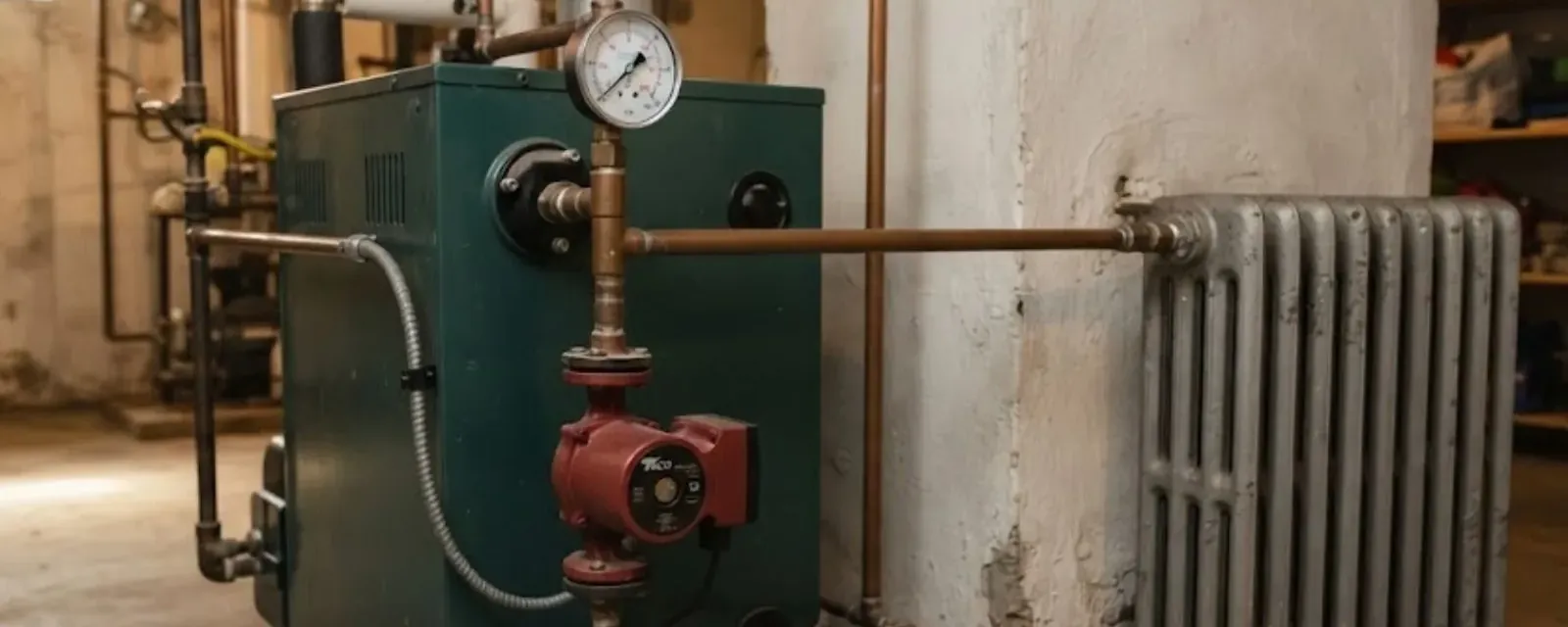
A boiler has two valves most owners meet at some point. The pressure relief valve opens to release steam or hot water if the system gets too hot or too high in pressure. The fill valve adds water to keep the system at its normal pressure.
A relief valve that drips or a fill valve that keeps feeding water both signal a fault worth fixing. Neither is a part to tinker with while the boiler is hot.
This guide explains what each valve does, which warning signs matter and what a homeowner can safely do. The short version: look, take notes, shut the boiler down if it is unsafe, and let a licensed plumber replace the valve.
Safety first: what to do if a boiler valve is leaking or venting
Hot water or steam from a relief valve can scald in seconds. Treat any active discharge as a hazard, even if the amount looks small.
- Stay clear of the valve and the end of its discharge pipe, which may be spraying hot water.
- Turn the boiler off at its switch or emergency shutoff, then let it cool before anyone touches it.
- Never cap, plug or screw down a relief valve. It is the last line of defense against overpressure.
- If you smell gas, leave the building at once and call 911 or the Nicor Gas 24-hour emergency line from outside.
Once the boiler is off and cool, call (773) 207-0518 to schedule a visit. The sitewide 24/7 line is open if the leak is heavy or the boiler room is flooding.
The two valves and what each one does
Knowing the job of each valve helps you tell a normal event from a failure.
Pressure relief valve
Opens when the pressure or temperature goes past a safe limit and lets water or steam out through a pipe that should end near the floor.
Fill valve (pressure reducing valve)
Feeds makeup water from the house supply and holds the system at its set pressure. A bad one can feed too much water.
Expansion tank
Not a valve, but linked. A failed tank lets pressure spike every time the water heats, which is a common reason relief valves drip.
Isolation and bleed valves
Shutoffs and air vents that let a plumber service one part of the system without draining the whole loop.
Relief valve dripping on your boiler?
Shut the boiler off and call (773) 207-0518. A licensed plumber will inspect the valve and give you a clear price before work starts.
Symptoms, likely valve problem and next step
The signs below are the ones plumbers see most often when a boiler valve is at fault.
| What you notice | Likely cause | What to do |
|---|---|---|
| Relief valve drips steadily | Valve seat worn or debris on the seat, or system pressure too high | Check the pressure gauge, shut the boiler off and call |
| Relief valve discharges when the boiler runs hot | Failed expansion tank or a stuck fill valve | Shut the boiler down and have the system checked |
| Pressure drops to zero over days | Small leak in the system or an air problem | Look for wet pipes and call before refilling more than once |
| Pressure climbs above normal after the boiler starts | Waterlogged expansion tank | Do not restart repeatedly, call for service |
| Constant sound of water entering the system | Fill valve stuck open | Close the manual fill line and call a plumber |
What a homeowner can safely check
Observation is safe. Disassembly is not. These checks take a few minutes and give a plumber valuable information.
- Read the pressure gauge. Note the reading when the boiler is cold and again when it is hot. The label on your boiler lists its normal range.
- Look at the end of the relief discharge pipe. Dampness, mineral crust or rust suggest it has been releasing water.
- Check around the fill valve and piping. Look for drips, green corrosion or white mineral deposits.
- Listen for water noise. Hissing from the fill line or banging in the pipes can point to a failing valve or trapped air.
- Photograph the nameplate and gauge. The model number and pressure reading help a plumber bring the right parts.
How a plumber replaces a boiler valve
A proper replacement is a short job when the boiler is easy to reach, but it follows a strict order.
Shut down and cool the boiler
Power off, fuel off, and wait until the water is cool enough to handle.
Isolate and relieve the pressure
Close the supply, then drain enough water to drop the system pressure below the valve.
Swap the valve with the correct rating
A relief valve must match the boiler's rated pressure and capacity. A plumber reads the nameplate to choose it.
Fit a safe discharge pipe
The outlet pipe must run downward and end where escaping water cannot scald anyone.
Refill, bleed and test
The system is refilled to the correct pressure, air is bled out and the new valve is checked for leaks under heat.
A full boiler repair visit also tests the expansion tank and controls, so the new valve does not start dripping again.
Repair now or replace the boiler?
A new valve is a modest repair, but a valve that fails often is sometimes the symptom of something larger: a cracked heat exchanger, a corroded system or a boiler near the end of its life. Ask the plumber to show you the old valve and explain why it failed. If sludge or scale is fouling the loop, flushing may be needed.
If your boiler is old and parts are scarce, a plumber can discuss whether replacement beats repeated repairs. A hot water boiler also serves some homes as the water source, and a failing one may be tied to your water heater repair questions if you use an indirect tank.
Illinois licenses plumbers under the Illinois Plumbing License Law (225 ILCS 320), and Blue Island code section 150.052 requires a permit for plumbing installation and repair. Whether a simple valve swap on your boiler counts is a question for the city. Call Building Safety before work starts.
Blue Island, IL: what local homeowners should know
About 64.7% of Blue Island's housing was built before 1970, and the median year built is 1961. Many of those buildings were designed around boiler or hydronic heat, which means older equipment and original valves are common. A valve that has been in service for decades is a reasonable candidate for replacement at the next service visit.
Chicago-area winters are a real test for a heating system. At O'Hare, January's average low is 18.8 degrees Fahrenheit and February's is 21.8, so a boiler that drips or loses pressure in November may not survive January. Schedule valve repair before the cold weather, not during a deep freeze.
Nearly half of Blue Island homes, 48.2%, are renter-occupied, and about 42.6% of housing is multi-family. In a rental building the owner is responsible for the boiler, so report a leaking valve to the landlord in writing.
For gas-fired boilers, Nicor Gas lists Blue Island among the towns it serves, so confirm your provider and keep its 24-hour line handy for a gas smell. We also serve Crestwood and Midlothian, where older heating systems raise the same valve questions.
Questions homeowners ask
A drip can come from a worn valve seat, debris on the seat, or system pressure that runs too high because of a failed expansion tank or fill valve. Shut the boiler off and have it checked.
We advise against it. The valve must match the boiler's rating, and a wrong choice or a poor discharge pipe is a safety risk. A licensed plumber handles it.
It depends on the boiler and the building. Read the label on your unit or ask a plumber, because the correct range differs between systems.
A slow drip is a planned repair. A valve that is spraying, a boiler losing pressure fast or any gas smell needs immediate action: shut the boiler down, and for gas, leave and call 911 or Nicor Gas.
Not by itself. If the cause is a bad expansion tank or a stuck fill valve, the new relief valve will start leaking again.
Usually the owner of the building. Report the problem in writing and keep a copy, and ask for an appointment with a licensed plumber.