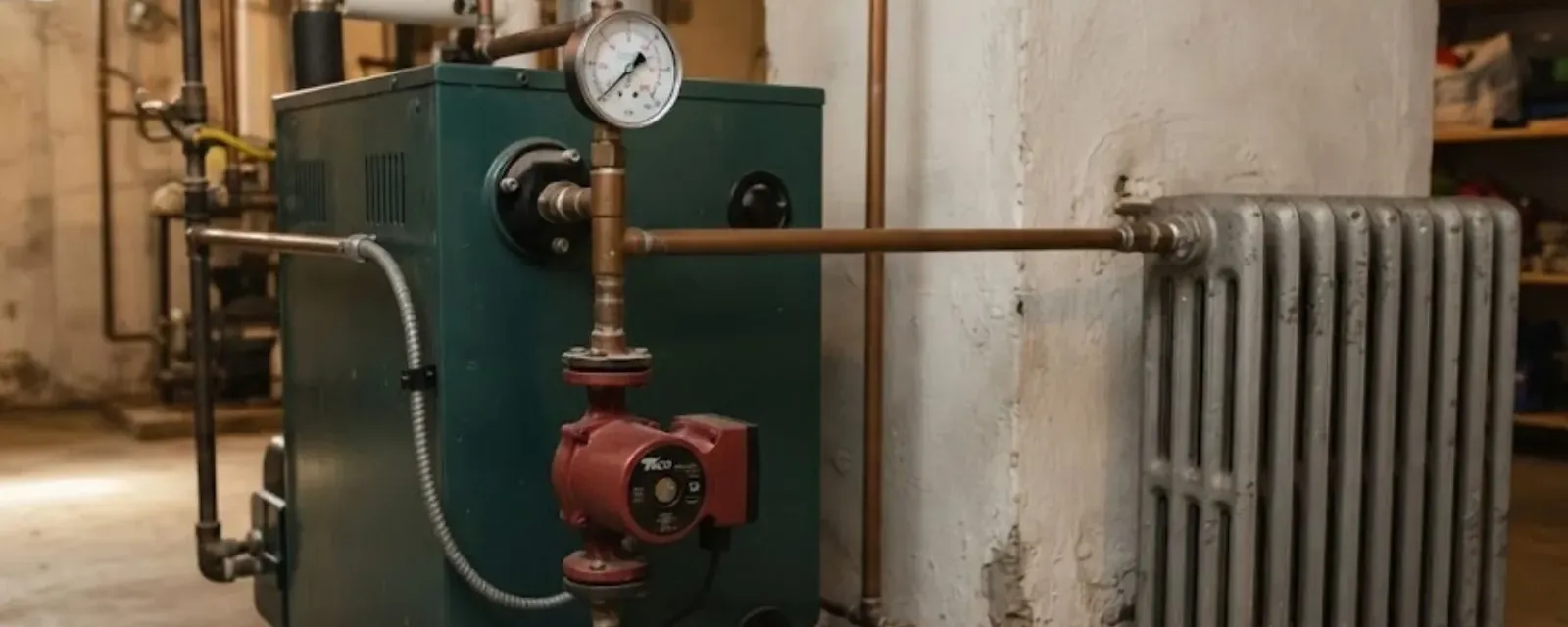
Boiler repair in Blue Island usually starts with a cold house and a gauge nobody understands. A boiler heats water (or makes steam) and sends it through pipes to radiators or baseboard units, so the problem might be the boiler, the pump, a valve, trapped air or a leak in the loop. Our licensed plumbers work through those possibilities in order.
This is planned work, and we book it around your day. Call (773) 207-0518 to schedule a same-day appointment when available. One firm rule comes first: if you smell gas, leave the building and call the gas utility or 911 from outside.
Smell gas? Leave before you call anyone
The rotten-egg odor added to natural gas means a possible leak. Do not flip switches, use a phone inside, or light anything. Walk out, leave the door open if you can do so safely, and call the gas utility from outside. Nicor Gas lists a 24-hour emergency and leak line on its contact page, and 911 is always right.
We do not promise gas line work on this page. Our plumbers handle the water side of a boiler system, and we tell you on the phone when a gas-fired burner or gas piping problem needs a gas-qualified technician instead.
Older Blue Island houses and the boilers inside them
About 64.7% of Blue Island's housing was built before 1970, and the median build year is 1961. Homes of that age often have a boiler feeding radiators or baseboard units, though we cannot tell from age alone, so check your basement or utility closet. A system that has run for decades may carry corroded piping, stuck valves and sludge.
Rentals matter here too. About 48.2% of occupied units are renter-occupied, and roughly one in four units sits in a building of five to nineteen units, where one shared boiler can serve many apartments. If you rent, tell your landlord first and then ask us what to say.
Signs your boiler or radiators need attention
Boilers usually announce trouble before they quit.
- Some radiators stay cold. Trapped air, a closed valve or a blocked pipe may be to blame.
- The pressure gauge reads too low or too high. Either one can shut a boiler down or trigger the relief valve.
- Banging, gurgling or kettle-like noises. These point to air, scale or low water levels.
- Water on the floor around the boiler. A pinhole in a fitting or a weeping relief valve can cause it.
- Heat that cycles on and off. A faulty thermostat, pump or sensor is common.
- Rusty or discolored water at a bleeder. That means corrosion inside the loop.
Boiler acting up?
Call (773) 207-0518 and a licensed plumber will talk through the symptoms and book your appointment.
Repair, service or replace: how to decide
Age and repair history matter more than any single symptom.
| Situation | Usual move | Why |
|---|---|---|
| One part failed, the rest is sound | Repair | A pump, valve or thermostat costs far less than a new boiler |
| Leak in the boiler body or heat exchanger | Often replace | Boiler body leaks usually cannot be patched reliably |
| Repeated repairs in a few seasons | Compare replacement | Add up repair bills against a new unit |
| Only some radiators cold | Service the loop | Bleeding, balancing or flushing may solve it |
| Gas burner or flue problem | Gas-qualified technician | Outside what this page promises |
Efficiency, fuel and the age of your radiators also shape the choice, and we talk through them on the call.
What happens during a boiler repair visit
The visit follows the water path from boiler to radiators.
Read the system
We check the gauge, the thermostat call for heat, the circulator pump and the expansion tank.
Test the safety devices
The pressure relief valve and low-water cutoff must work, because they protect the boiler and your home.
Trace the fault
Using gauges, a thermometer and line-by-line checks, we find air, a blockage, a failed valve or a leak.
Explain options
You hear repair versus replace, with a clear price before work starts.
Repair and retest
We fix the water-side problem, bleed the loop and watch the system come up to temperature.
Parts that give boilers trouble
These are the usual suspects in a no-heat or low-heat call.
Pressure relief valve
A safety valve that opens to release excess pressure. A valve that drips or discharges should be inspected, never capped.
Circulator pump
It pushes hot water through the loop. A failed pump leaves the boiler hot and the radiators cold.
Expansion tank
A waterlogged tank causes pressure swings and repeated valve discharge.
Zone valves and radiator valves
Stuck valves block flow to a room or an entire zone.
Cold weather and why timing matters
The NWS Chicago-area (O'Hare) January average low is 18.8 F, and February averages 21.8 F. A boiler that fails then can drain heat from a house within hours, and exposed pipes in a cold basement can freeze. If your heat fails, open cabinet doors under sinks and keep a tap dripping on exposed pipes.
Book service in early fall, not mid-January, when the schedule fills. For a frozen or burst pipe, see burst pipe repair. If the water heater shares your basement and is leaking, water heater repair covers it, and plumbing installation covers new radiator or loop piping.
Boiler makers publish installation and service instructions for each model, and a repair should follow the ones for yours. The piping around the boiler is plumbing repair, which Blue Island code section 150.052 says needs a permit. If you smell gas, leave the building and call the gas utility or 911 first.
What affects the cost of boiler repair
We give you a clear price before work starts. These factors move it.
Insurance may cover sudden burst damage, but wear, gradual leaks and corrosion are usually excluded, so check your policy. Want your real number? Call (773) 207-0518.
Boiler and radiator questions
A drip can mean excess pressure, a failed expansion tank or a worn valve. Do not cap it. Call us so a plumber can find the cause.
We handle the water side of boilers. If the problem is the burner, flue or gas piping, we say so and refer you to a gas-qualified technician rather than overpromise.
Leave the building immediately. Call the gas utility's emergency line or 911 from outside. Do not turn lights on or off.
Trapped air, a stuck zone valve, a failed circulator or a blocked pipe are common causes. A plumber can trace which one.
Tell your landlord or property manager first, since the boiler is usually the building's equipment. We can talk to the manager if they call us.
Compare repair cost, repeated failures, safety and efficiency. A single failed part usually favors repair, while a leaking boiler body usually favors replacement.