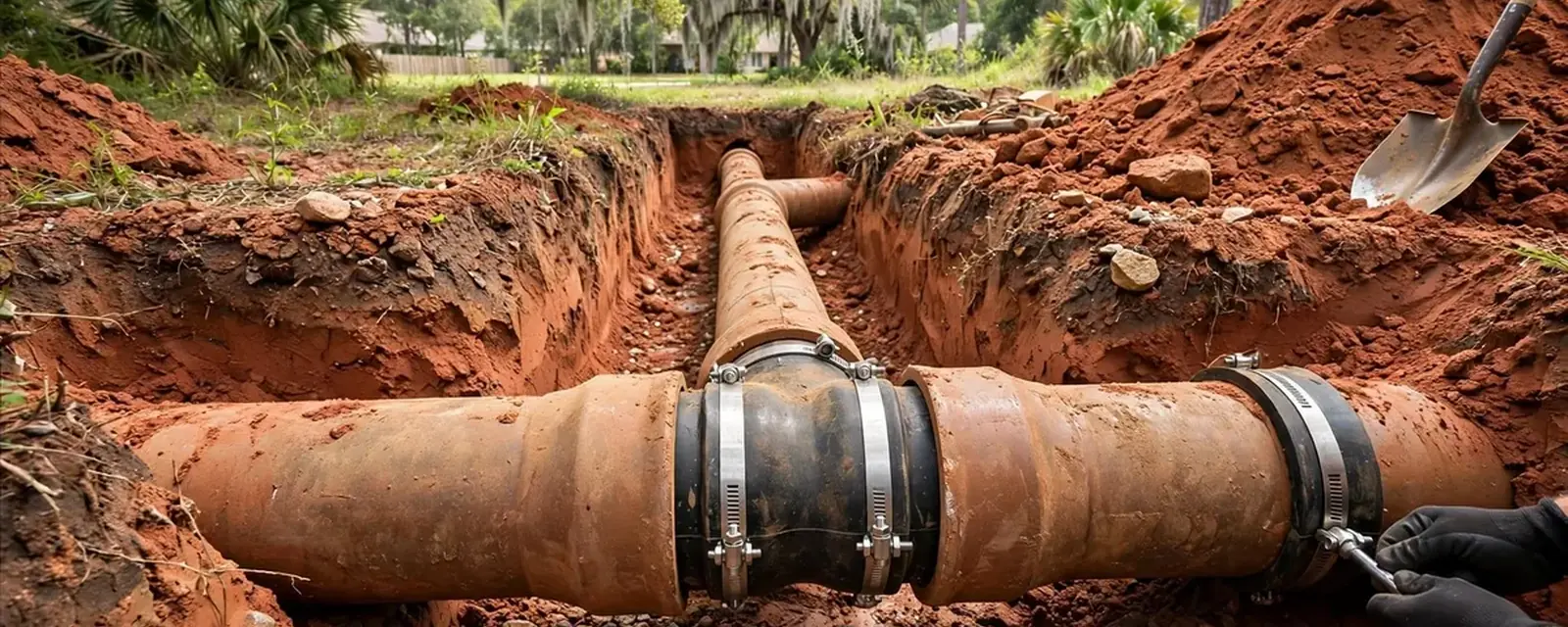
Sewer main line repair means fixing the pipe that carries all of your home's wastewater out to the public sewer. If every drain in the house is slow at once, or water backs up in the basement floor drain, the blockage or break is probably in that line and not in a single fixture.
A camera inspection finds the problem, and a crew doing sewer line repair can choose the fix. It is usually a cleaning, a spot repair, a liner or a replacement section.
In Blue Island the question of who owns what gets tangled by a combined sewer system and a regional agency downstream. Knowing the difference saves you from paying for a repair on pipe that is not yours, and from waiting on a fix that only you can order.
Signs the main line is the problem
A main line problem rarely announces itself with one dramatic event. It builds, and the early clues are easy to dismiss.
- Several drains slow at the same time. A tub, a toilet and a kitchen sink that all struggle on the same day point away from a single fixture.
- Bubbling or gurgling in a toilet or floor drain. Air pushed through a blocked line looks for the easiest exit, often the lowest trap in the house.
- Water in the basement floor drain. Backup in the lowest drain is the classic sign of a line that cannot carry the flow.
- Sewer odor in the yard or basement. A broken section outside can leak gas and wastewater into the soil.
- Green, soft or sunken spots over the line. A leaking section feeds the lawn and can wash soil away from under it.
If sewage is already coming up into the house, stop running water and call (773) 207-0518. Keep people away from the wet area, and do not touch electrical equipment standing in the water.
Which pipe is yours, and which belongs to the city?
Under Blue Island's city code, each main building has its own house sewer, and that pipe must be at least 6 inches across and made of tile or cast iron. The public sewer in the street is part of the city system.
Where your responsibility ends and the city's begins along the connecting pipe is something to confirm with the Blue Island Water and Sewer Department at City Hall, 13051 Greenwood Avenue, before you sign a repair contract.
Further downstream, the city's sewers discharge through a diversion chamber into interceptor sewers owned and operated by the Metropolitan Water Reclamation District (MWRD). That means a backup caused by a full interceptor or tunnel is a regional matter, while a root-clogged or cracked house sewer is yours. A camera inspection that shows where the blockage sits settles the question quickly.
Backups in more than one drain?
Stop running water and call (773) 207-0518. A licensed plumber can find the blockage with a camera and tell you the price before work starts.
Repair options compared
The right choice depends on what the camera shows and on how much of the line is damaged. A plumber should show you the video and explain why one method fits your pipe.
| Method | Best for | Trade-off |
|---|---|---|
| Cleaning or hydro jetting | Grease, silt and roots in a pipe that is still sound | Does not fix a crack or a collapse, so roots may return |
| Spot repair by digging | One short broken or offset section | Requires an excavation and yard or floor restoration |
| Cured-in-place liner | Long cracked clay or cast iron runs with little shifting | Needs a pipe that is open enough to line and mostly in shape |
| Pipe bursting or full replacement | Collapsed, bellied or heavily root-infested lines | Higher cost and more disruption, with the longest service life |
How a sewer main repair usually goes
A well-run job follows a clear order, and each stage should be explained before it starts.
Camera inspection
A small camera on a flexible rod travels through the cleanout and records the pipe, so the break or blockage is located by footage and by depth.
Clear the line
A drain machine or a high-pressure jetter removes roots and debris so the repair crew can see the true condition of the pipe.
Plan and permit
The plumber chooses a repair method, prices it clearly, and arranges any permit the work needs.
Utility marking before any digging
Anyone who digs needs a JULIE ticket first, which is a call to 811, so that gas and other buried lines are marked.
Repair, inspect and restore
The new section goes in, the inspector checks it before it is covered, and the area is backfilled and cleaned up.
Permits, licensing and who is allowed to do the work
Blue Island's code requires a plumbing permit for installation and repair. The application goes through the Building Department, and the permit has to be presented to the Water and Sewer Department before work begins. The contractor must also call the plumbing inspector before any pipe is covered.
Under the Illinois Plumbing License Law (225 ILCS 320), the permit is tied to a valid plumbing license. You can check any plumber's license on the Illinois Department of Public Health plumbing license verification page before you agree to a job. Contractors who work in the city must also be registered with Blue Island.
What affects the cost of a sewer line job
Length of the damaged section, depth of the pipe and the repair method have the biggest effect on price. Digging under a driveway, a porch or a finished basement floor adds restoration work. Access matters too: a line with a cleanout is easier to inspect and to service than one without.
Insurance is a separate question. Standard homeowners policies often exclude sewer backup unless you added an endorsement, and gradual pipe wear is rarely covered, so read the policy before you assume a claim is possible. For your own number, call (773) 207-0518 and ask for a clear price before work starts.
Preventing a second repair
Keep grease, wipes and paper towels out of the drains, and book drain cleaning if you see slow drains returning more than once a year. A cleanout near the foundation gives a plumber direct access and makes future inspections cheaper.
If trees grow near the line, roots are the likeliest cause, and a liner or replacement section that seals the joints is the lasting answer. A scheduled sewer inspection gives you a recorded view of the pipe before a small problem becomes a backup.
Blue Island, IL: what local homeowners should know
The majority of Blue Island is served by a combined sewer system that carries household wastewater and storm runoff in the same pipes. The city's overflow notification plan lists three overflow points into the Calumet-Sag Channel, at Irving Avenue and at Division Street on both banks, all tied to the MWRD's deep tunnel system.
If you get a backup only during heavy rain, the public system may be the cause and a camera on your own line will show whether it is clear.
County flood planning documents describe repeated urban flooding in low-lying parts of the city, such as around Washington Street and Vermont Street near California, and blame the age and capacity of the combined sewer.
A nonprofit study counted 469 flood-related insurance claims in ZIP 60406 from 2007 to 2011 and recommended check valves and overhead sewers for backup-prone homes. Ask a plumber whether a backwater valve makes sense for a basement drain at your address.
About 64.7% of homes here were built before 1970, so older clay, tile and cast iron house sewers are common. Neighboring villages such as Alsip and Midlothian are served by separate sewer systems according to the MWRD table, so the advice for a Blue Island backup differs from what a homeowner in those villages would hear.
Questions homeowners ask
Run water in two or three fixtures. If more than one is slow, or a basement floor drain bubbles, the blockage is probably in the main. A camera inspection confirms it.
The house sewer serving your building is generally yours, while the public sewer in the street is part of the city system. Call the Blue Island Water and Sewer Department to confirm where the line of responsibility sits for your property.
The city code requires a plumbing permit for installation and repair, and the Building Department handles it. A licensed plumber normally applies on your behalf.
A liner can seal cracks and open joints in a pipe that is still round and open. A collapsed or heavily offset pipe usually needs a section replaced.
Many policies do not cover sewer backup unless you bought a specific endorsement, and gradual wear is rarely covered. Check your policy or ask your agent before the work.
Yes, whoever digs must call JULIE at 811 and wait for utilities to be marked. JULIE asks for at least two working days of notice, so the excavator normally makes the call, not the homeowner.