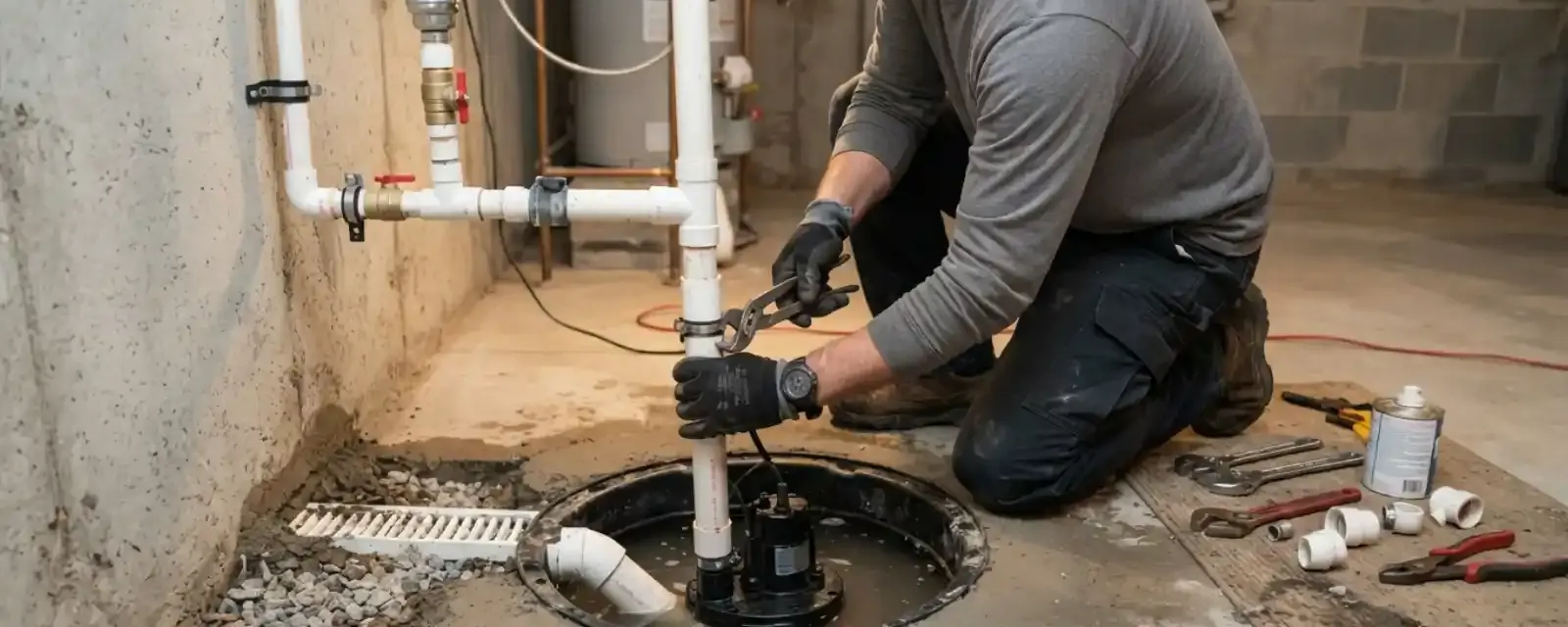
A submersible sump pump sits inside a basin in the lowest part of your basement and pushes water out through a discharge pipe when a float switch rises. Installation means setting or reusing a pit, placing the pump, fitting a check valve, running the discharge line outside and testing the system under load. A plumber can usually finish a straightforward swap in a few hours.
Submersible models run quietly because the motor sits underwater, and they handle debris better than a pedestal pump. This guide explains the parts, the steps, the choices between models and the Blue Island conditions that make a pump worth planning before the next big storm.
Submersible or pedestal: which one fits
The two main designs solve the same problem in different ways. The right pick depends on the pit, the noise you can live with and how often the pump runs.
| Feature | Submersible | Pedestal |
|---|---|---|
| Where the motor sits | Underwater inside the basin | Above the basin on a column |
| Noise | Quiet, muffled by water | Louder, motor is exposed |
| Pit size needed | Needs room for the whole pump | Fits a narrow pit |
| Debris tolerance | Better with fine grit when a screen is fitted | Can clog if the intake is exposed |
| Service access | Pulled up from the pit | Motor is easy to reach |
| Typical use | Homes with frequent water or finished basements | Occasional use or tight spaces |
For most Blue Island basements that see water several times a season, a submersible pump in a lined basin is the common choice.
How installation works from start to finish
A new pit takes more labor than a swap in an existing one. The sequence below covers both, with the extra steps flagged.
Locate the low point
The plumber finds where water collects. A new pit goes there, or at the corner where drain tile meets the floor.
Cut and dig the pit
A concrete saw opens the slab and the crew removes soil to fit a basin. Skip this step if a pit already exists.
Set the basin and pump
The liner sits level on a gravel bed. The pump goes on a stable base so grit cannot clog the intake.
Fit the check valve and discharge
A check valve keeps water from draining back into the pit. The pipe runs through the rim joist and out through the wall to a point away from the foundation.
Wire and test
The pump plugs into a GFCI outlet. The plumber pours water into the pit, watches the float switch and confirms the pump clears the basin.
Ask whether the quote includes a backup. A battery or water-powered backup keeps working when storms knock out power.
Know where the discharge line goes
The discharge pipe is the part homeowners get wrong most often. Pumped water must travel away from the house, not back toward the foundation, and it should not feed into a drain that cannot handle the load.
Blue Island is served mostly by a combined sewer system that carries both household waste and storm runoff. We did not find a published Blue Island code rule on where a sump pump may discharge, so call the Building Safety Department at City Hall before you route the line. A short conversation prevents a rework after the pipe is already set.
Water in the basement tonight?
Call (773) 207-0518 on the 24/7 emergency line. Keep clear of the water if it is near outlets or the electrical panel.
Choices to settle before the plumber arrives
These decisions change both the work and the final price, so settle them before the crew shows up.
- Existing pit or new pit. A new pit means saw cutting, digging and patching the slab.
- Power backup. Battery, water-powered or a second pump. Pick one if water has ever reached the floor in an outage.
- Outlet and circuit. The pump needs a GFCI outlet. A dedicated circuit avoids tripped breakers.
- Discharge route. Choose a spot that drains away from your foundation and your neighbor's.
- Alarm or monitor. A high-water alarm warns you before the basin overflows.
Digging outside: call 811 first
If the discharge line needs a trench, someone must call JULIE at 811 before any digging starts. Illinois law puts that duty on the excavator, not the homeowner or the company paying for the work. A ticket requires at least two business days of notice, and the tolerance zone around marked lines is 18 inches on each side, where crews dig by hand.
A plumber who handles the ticket protects you from striking a gas or electric line. Ask the crew to confirm the ticket number before the trench opens.
Why Blue Island basements deal with this
Cook County's hazard plan notes that Blue Island has seen urban flooding mainly because of the age and capacity of its combined sewer system, with trouble spots in low areas such as Washington Street and Vermont Street near California. It also says structures along the Cal-Sag Channel have flooded. That is the background for a lot of local basement water.
A sump pump handles groundwater at the slab. It does not stop sewage coming back up through a floor drain when the city sewer fills. If you see water from the drain, that is a different problem. Our basement waterproofing team can look at seepage and drainage together, and a backwater valve on the sewer line is the usual answer for backup.
The same split applies across town lines. Riverdale sits to the southeast on very flat ground, about 0.15% slope according to its RainReady guide, and reports sewage backups in its northeast homes. Alsip, on the west side of Blue Island, lies in the Calumet-Sag Channel watershed planning area.
Maintenance that keeps the pump alive
Test the pump twice a year by pouring a bucket of water into the pit. The float should rise, the pump should start and the water should clear within a minute or two. Listen for grinding, rattling or a motor that hums without pumping.
Winter adds one more check. The Chicago-area January average low is 18.8 degrees Fahrenheit, according to National Weather Service normals for O'Hare, so a discharge line that ends right at the wall can freeze solid. Make sure the outlet has a path for water to escape even if the end ices over. Our sump pump service covers installation, repair and replacement when a unit fails.
Plumbing work in Blue Island needs a permit under section 150.052, and the Illinois Plumbing Code (77 Ill. Adm. Code 890) governs how it is built. The research behind this guide found no city rule written specifically for sump pumps, so ask Building Safety at City Hall what applies to your discharge before you start.
Blue Island, IL: what local homeowners should know
The Cook County hazard mitigation plan says most of Blue Island is in a moderate or high urban flooding susceptibility zone, and it names Washington Street and Vermont Street near California as low-lying trouble spots. If your home sits near those streets, plan for a pump with a backup and a clear discharge route.
RainReady, a program of the nonprofit Center for Neighborhood Technology, counted 469 flood-related insurance claims in ZIP 60406 between 2007 and 2011, with more than $1,279,191 paid. It calls the northeast neighborhood 'the bowl' and recommends check valves and overhead sewers among its fixes. That is a nonprofit's finding, not a city program, and we found no city rebate for these upgrades.
Questions homeowners ask
Swapping a pump in an existing pit often takes a few hours. A new pit, with slab cutting, digging and patching, takes longer, and the concrete needs time to cure before it carries load.
A backup helps when storms knock out power, which is often when groundwater is highest. If your basement has been wet before, it is worth asking your plumber about a battery or water-powered unit.
Check with the city first. Blue Island is mostly on a combined sewer system, and we did not find a published rule on sump discharge in the city code, so ask Building Safety before you connect anything.
Twice a year is a good habit, plus before the spring storm season. Pour water into the pit and confirm the pump starts, clears the basin and shuts off.
No. A sump pump handles groundwater at the slab. Sewage rising through a floor drain comes from the sewer line and calls for a backwater valve or an overhead sewer. A plumber can sort out which problem you have.
Yes. The 24/7 line is open when a pump fails or the pit is overflowing. Stay out of standing water near electrical outlets, and if you can reach it safely, unplug the pump before touching it.