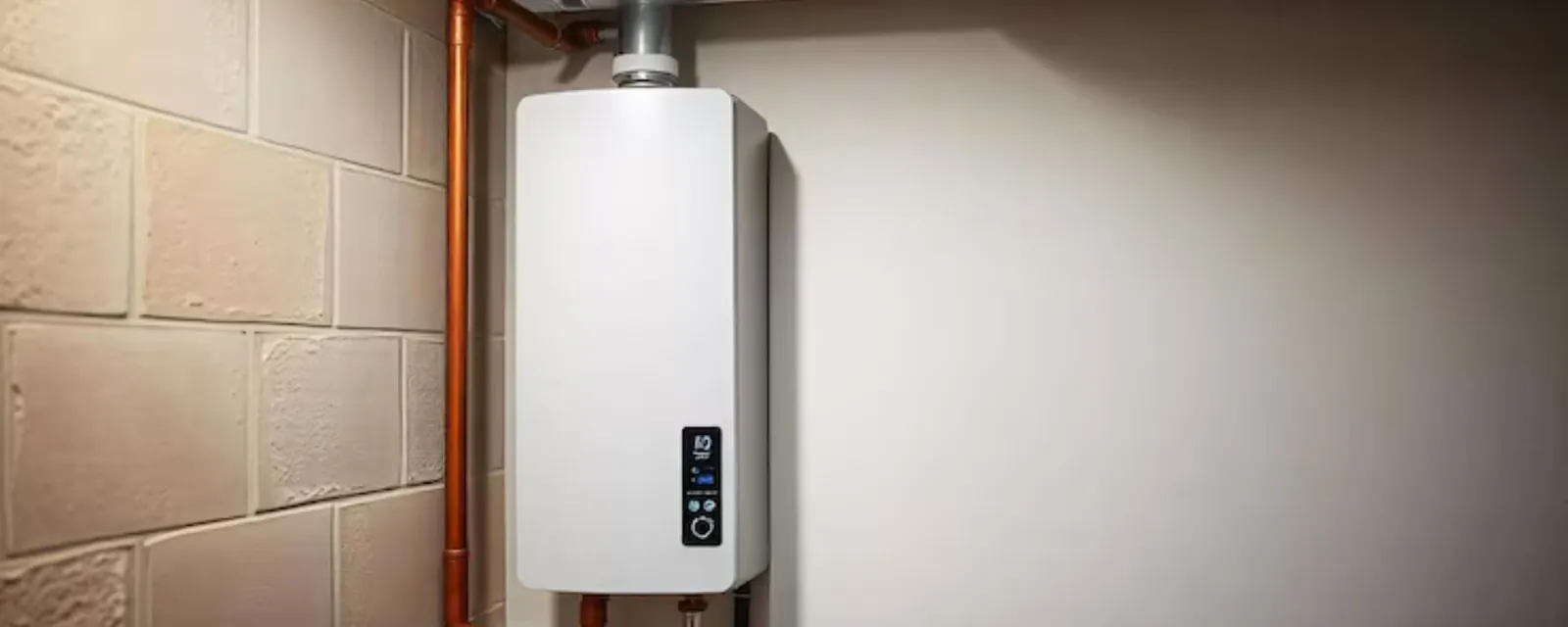
A tankless water heater that stops working usually has one of a handful of problems. The usual suspects are no power, no gas, a blocked vent and scale inside the heat exchanger. A flow that is too low to trigger the burner, or a fault the unit shows as a code, round out the list. Several of these you can check in ten minutes without tools. Others, such as gas valve faults and cracked heat exchangers, need a licensed plumber.
This guide walks through the checks in a safe order, explains what the common symptoms mean and shows where a homeowner should stop. If you smell gas at any point, leave the building and call the gas utility or 911 before you do anything else.
If you smell gas, stop here
Gas-fired tankless units burn natural gas, so a leak is a real risk. Do not light anything, flip switches or try to find the leak. Get everyone out first.
- Leave the building immediately and take other people and pets with you.
- From outside or a neighbor's house, call 911 or the gas utility's 24-hour emergency line.
- Do not use phones, light switches or doorbells inside until a utility crew says it is safe.
- Call a plumber only after the utility clears the building.
Symptoms and what they usually mean
Match what you see to the likely cause. The last column shows whether a homeowner check is reasonable.
| Symptom | Likely cause | Your next step |
|---|---|---|
| No hot water, display is dark | No power or a tripped breaker or GFCI | Check the outlet and breaker |
| Display lit, no hot water | Gas valve closed, gas off or a fault code | Check the gas valve, read the code |
| Water goes cold for a few seconds | Low flow, scale or a short cycle | Open a second tap, then clean the filter |
| Water is lukewarm only | Scale on the heat exchanger or low gas | Plumber, to flush the unit and test gas pressure |
| Error code appears | Vent, flame, sensor or flow fault | Look up the code in the manual, then call |
| Unit clicks but never lights | Igniter, flame sensor or gas supply | Plumber |
The manual usually lists every code with a one-line meaning. Keep it near the unit. If you have lost it, the model number on the label lets you find it online.
Safe checks in a sensible order
Work through these in sequence. Each step takes a few minutes.
Check power
Look for a lit display, then test the outlet and the GFCI. Reset the breaker if it has tripped.
Check the water supply
Confirm the cold inlet valve is fully open and other taps are running normally.
Check the gas valve
Confirm the handle is parallel to the pipe, which is open. Do not touch anything if you smell gas.
Read the code
Write down the number or letters from the display and compare with the manual.
Look at the vent and condensate line
Check outside for ice, snow or a nest at the vent termination. A condensing unit also drains water through a small tube that can freeze.
If checks one through four look fine and the code points to flame or gas, stop and call. Those parts are not do-it-yourself.
Tankless unit showing a code?
Call (773) 207-0518 with the code and model number. Same-day appointments are available when the schedule allows, and the 24/7 line stays open.
The cold water burst in the middle of a shower
Many tankless owners notice a cold slug of water between uses. The unit shuts off when flow drops below its minimum, and it needs a moment to ignite again when you open the tap. The water already in the pipe between the heater and the fixture is also cold, which can feel like a failure when it is not.
If the cold burst gets longer or happens mid-shower, check the faucet aerator for grit, open one tap fully instead of two partly and look at the inlet filter on the heater. A restricted filter lowers flow and can drop it below the trigger point. Scale is the next suspect, and a plumber can flush it.
Scale and your tap water
Mineral scale builds on the heat exchanger of any water heater, and the narrow passages in a tankless unit are quick to show it. Symptoms include lukewarm output, longer warm-up and error codes about temperature or flow.
Blue Island buys its water from Chicago, and the city's 2025 water quality report does not list hardness. That leaves your own tap as the better test. A test strip tells you whether to flush the unit once a year or more often. A plumber can run a descaling flush through the heat exchanger and clean the filter during the same visit.
Winter problems: frozen vents and condensate lines
Chicago-area January lows average 18.8 degrees Fahrenheit according to National Weather Service normals for O'Hare, and February averages 21.8. Cold like that can freeze the small condensate line on a high-efficiency tankless unit, trigger a code and shut the burner down. A vent that ends near snow drifts may also be blocked from outside.
Look outside for ice or a snowdrift against the vent. Clear it by hand if you can reach it safely from the ground. If the condensate line is frozen inside the house, thaw it gently with warm air. Do not use an open flame.
What stays with the plumber
Some repairs are beyond a safe homeowner fix, and gas appliances are at the top of the list.
Gas valve and burner faults
The unit lights, then drops out, or never lights. These need combustion testing.
Heat exchanger problems
A cracked or clogged exchanger needs a pro and sometimes a replacement.
Vent repair
A damaged or poorly pitched vent can send exhaust into the house.
Scale flush and service
A pump, hoses and a descaling solution make this a quick job for a plumber.
Choosing between service and replacement
A tankless unit that needs a flush, a filter clean or a new sensor is worth repairing. One with a cracked heat exchanger on an older unit may be worth replacing. Our tankless water heater service covers both service and installation, and water heater repair handles other types of failure. If you are weighing a move from a tank, water heater installation explains the setup work.
Homes in Alsip, which touches Blue Island, and in Crestwood, about three miles to the southwest, see the same winter issues. Call (773) 207-0518 to book a visit, and the plumber will give a clear price before work starts.
Tankless units are installed to the manufacturer's installation instructions and to the Illinois Plumbing Code (77 Ill. Adm. Code 890), so any repair that touches venting, gas or water connections should come from a licensed plumber. You can check a licence on the Illinois Department of Public Health plumbing lookup.
Blue Island, IL: what local homeowners should know
Nicor Gas lists Blue Island among the municipalities it serves in a tariff sheet, though the sheet is an older revision, so confirm service for your address. Nicor's 24-hour emergency and leak line is 888.Nicor4U. If you smell gas around a tankless heater, leave the building and call that line or 911 from outside.
Blue Island's water comes from the City of Chicago, and the city's 2025 consumer confidence report does not list hardness. Test your own tap before deciding how often to flush a tankless unit.
The Chicago-area January average low is 18.8 degrees Fahrenheit at O'Hare, and O'Hare averages 38.4 inches of snow a year. Both numbers argue for a clear path at the vent and a protected condensate line.
Questions homeowners ask
The unit needs a minimum flow to ignite, and the pipe between the heater and the tap holds cold water that must clear first. A longer cold gap points to a restricted filter or scale.
Follow the manufacturer's schedule. Hard water means more frequent flushing, and Blue Island's report does not list hardness, so a test strip on your own tap tells you more than a guess.
Codes vary by brand and model. The manual lists each one. Typical codes relate to ignition, vent, flow and sensors. Write the code down and call a plumber if it returns after a reset.
The unit, the vent and the condensate line can all be affected. Keep the vent clear, protect any condensate tube and ask a plumber about freeze protection if the heater is in a cold space.
Leave the building and call the gas utility's 24-hour emergency line or 911 from outside. For Nicor customers that line is 888.Nicor4U. Call a plumber only after the utility clears the building.
Our 24/7 line is open, and a plumber can talk through what to check. A heater that is simply not working is a planned repair, so same-day appointments are offered when available. Gas smell or flooding is a true emergency.