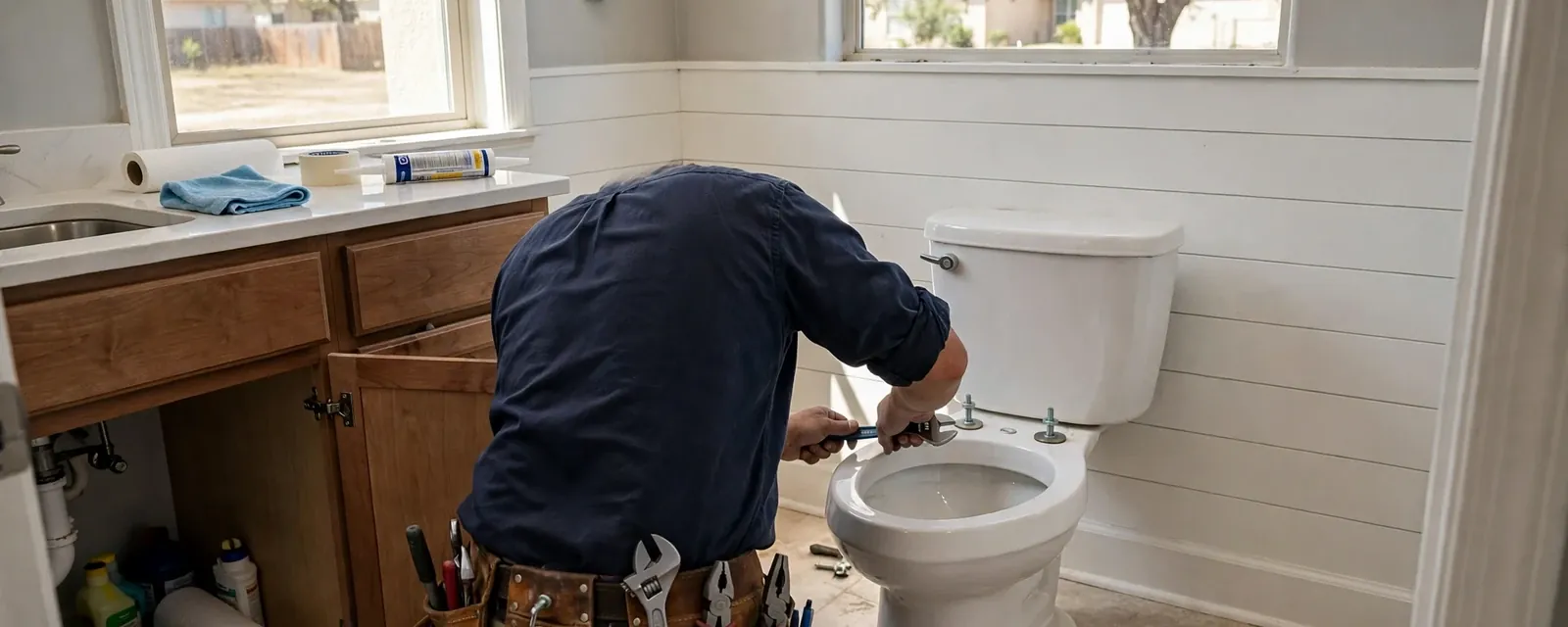
To unclog a toilet, stop flushing, lift the tank lid and close the flapper if the bowl is rising, then seat a flange plunger so the rubber covers the drain hole completely. Push down gently once to release trapped air, then pump with firm, short strokes for 15 to 20 seconds. If the water drains in a swirl, the clog is gone.
Most people make the clog worse by flushing again to see what happens. A second flush sends more water into a bowl that cannot drain, and the overflow lands on your floor. Work through the steps below in order, and you will know within about ten minutes whether this is a plunger job or a plumber job.
The bowl is rising right now: do this first
Water on the way to the rim can be stopped in seconds. Take the tank lid off and push the rubber flapper down into its seat so no more water enters the bowl. If the flapper will not hold, turn the shutoff valve on the wall or floor behind the toilet clockwise until it stops.
- Do not flush again, even if the bowl looks like it is draining slowly.
- Close the flapper or the shutoff valve behind the toilet to stop the refill.
- Lay towels around the base and keep children and pets out of the bathroom.
- Stay away from wet outlets and floor heaters if water has reached the floor.
If water is also coming up in the tub or shower, stop here. That points to the main drain, not the toilet, and a plunger will not fix it. Call (773) 207-0518 and a licensed plumber can come out on the same day when appointments are open, or at night through the 24/7 emergency line.
The plunger method, step by step
A flange plunger, the kind with a smaller rubber sleeve folded inside the cup, fits a toilet drain far better than the flat sink plunger. If your plunger is flat, it can still work, but it takes more effort to get a seal.
Add water if the bowl is low
The cup needs to sit under water to push it. Pour in a bucket of warm tap water until the bowl is about half full, without letting it spill.
Seat the plunger
Tilt it so air escapes as it goes in, then press the rubber sleeve into the drain opening until the cup flattens against the porcelain.
Push gently, pull sharply
The first push forces air into the trap, so go easy. The pull stroke does most of the work because it tugs the clog loose.
Pump 10 to 15 times
Keep the seal and repeat in a steady rhythm. Listen for a gurgle and watch for the level to drop.
Test with a small amount of water
Pour a half bucket into the bowl. If it drains normally, wait a minute, then flush once.
If the water level does not move after three rounds of plunging, you are probably dealing with something firmer than paper. Toys, wipes, cotton products and thick wads of paper often need an auger instead.
What kind of clog is it? A quick decision table
The way the bowl behaves tells you a lot. Use this table to decide whether to keep trying or to stop.
| What you see | Likely cause | What to do |
|---|---|---|
| Bowl fills high then drains slowly | Soft clog of paper or waste in the toilet trap | Plunge with a flange plunger for several rounds |
| Bowl does not move at all | Solid object or packed wipes in the trap | Try a toilet auger, or call a plumber if it will not clear |
| Gurgling in the toilet when a sink or washer drains | Partial blockage in the branch line or a venting problem | Stop using other fixtures and call for an inspection |
| Water backs into the tub or floor drain | Blockage in the main drain or house sewer | Stop all water use and call right away |
| Toilet clogs again within days | Damaged line, root intrusion or a recurring blockage downstream | Book a camera inspection |
Bowl still rising or backing up elsewhere?
Shut off the water behind the toilet and call (773) 207-0518. A licensed plumber will give you a clear price before work starts.
Safe backups if the plunger is not enough
Before you reach for a chemical, try the gentler options. They solve a good share of stubborn clogs without risk to your pipes or your skin.
- Hot water and dish soap. Squirt a generous amount of dish soap into the bowl, then pour in a bucket of hot (not boiling) tap water from waist height. Boiling water can crack porcelain, so skip it.
- Toilet auger. A closet auger has a curved shaft that protects the porcelain. Feed the cable in, crank slowly, and retrieve or break up the blockage.
- Wet and dry vacuum. A shop vacuum set to wet mode can pull a clog out of the trap. Seal the hose around the drain and be ready for a messy cleanup.
- Skip drain chemicals. Caustic cleaners sit in a blocked bowl and can splash on skin. They can also hurt older fittings and make life harder for the plumber who arrives next.
When to stop and call a plumber
A bowl that will not clear after a fair try is not a failure on your part. It tells you the blockage is further down.
The auger will not pass
Resistance deep in the line can mean a lodged object or a collapsed section, and forcing the cable can scratch the bowl.
Several fixtures are slow
When the toilet, shower and kitchen sink all drain badly, the main drain is the likelier culprit.
Sewage smell or standing sewage
Treat it as a health hazard. Keep everyone out of the area and avoid touching the water.
Repeated clogs
Two or three clogs in a month point to a line problem, an old toilet with a weak flush, or roots in the line outside.
A plumber can run a drain machine through the line or send a camera down to see what is blocking it. If the problem is in the house sewer itself, the fix may involve drain cleaning or hydro jetting rather than anything at the toilet.
Why a toilet clogs in the first place
Most toilets clog from too much paper at once or from items that were never meant to be flushed. Wipes labeled flushable still tangle in the trap, and they snag on roughness in older cast iron pipe. Paper towels and feminine products do not break down the way toilet paper does.
Older low-flow models from the 1990s sometimes flush with too little force to carry waste through the whole line. If a toilet clogs every few weeks even with careful use, the problem may be the fixture itself. In that case a toilet repair or replacement visit makes more sense than repeated plunging.
A toilet clog that also slows a tub points toward the house sewer. Section 52.009 of Blue Island's code describes those sewers as tile or cast iron, at least 6 inches across, so an aged, rough pipe is a likely suspect. Plumbing work for hire falls under the Illinois Plumbing License Law (225 ILCS 320).
Blue Island, IL: what local homeowners should know
About 64.7% of Blue Island's homes were built before 1970, and the median year built is 1961. That matters at the toilet because older houses often have older drain lines with rough interiors, where paper and wipes catch more easily. If your toilet clogs more than once or twice a year, ask a plumber to look at the line, not just the bowl.
Most of the city is served by a combined sewer system that carries both household wastewater and storm runoff. During a heavy rain, a gurgling toilet or a bowl that burps may be a sign that the public sewer is full, not that your trap is blocked. Wait for the rain to ease, avoid flushing and running water, and call if the backup does not go away.
Each main building in Blue Island has its own house sewer, and the city code sets the minimum diameter at 6 inches. A plunger cannot reach that pipe, so a backup that affects every drain in the house usually needs a drain machine. We also dispatch to nearby Alsip and Riverdale, so a call from either side of the city line reaches the same 24/7 team.
Questions homeowners ask
A slow drain after a flush usually means the trap is partly blocked. Plunge with a flange plunger, and if the problem returns within a few days, have the line checked.
We recommend against it. Chemicals sit in the bowl, can splash, and may damage fittings. A plunger or closet auger is safer, and a plumber has stronger tools if those fail.
Put them in the trash instead. They do not break down quickly enough and are a common cause of blockages in older lines and in the public sewer.
It can. If the toilet gurgles when other fixtures drain, or if the tub bubbles when you flush, the cause is often a partial blockage or a vent problem farther along the line.
The price depends on whether the clog is in the bowl or the main line, and how much equipment is needed. Call (773) 207-0518 and the plumber will explain the price before work starts.
Much of the city sits on a combined sewer system, so storm runoff and household waste share the same pipes. When the public line fills in a storm, water can push back into low fixtures. Stop flushing and call if it does not clear.