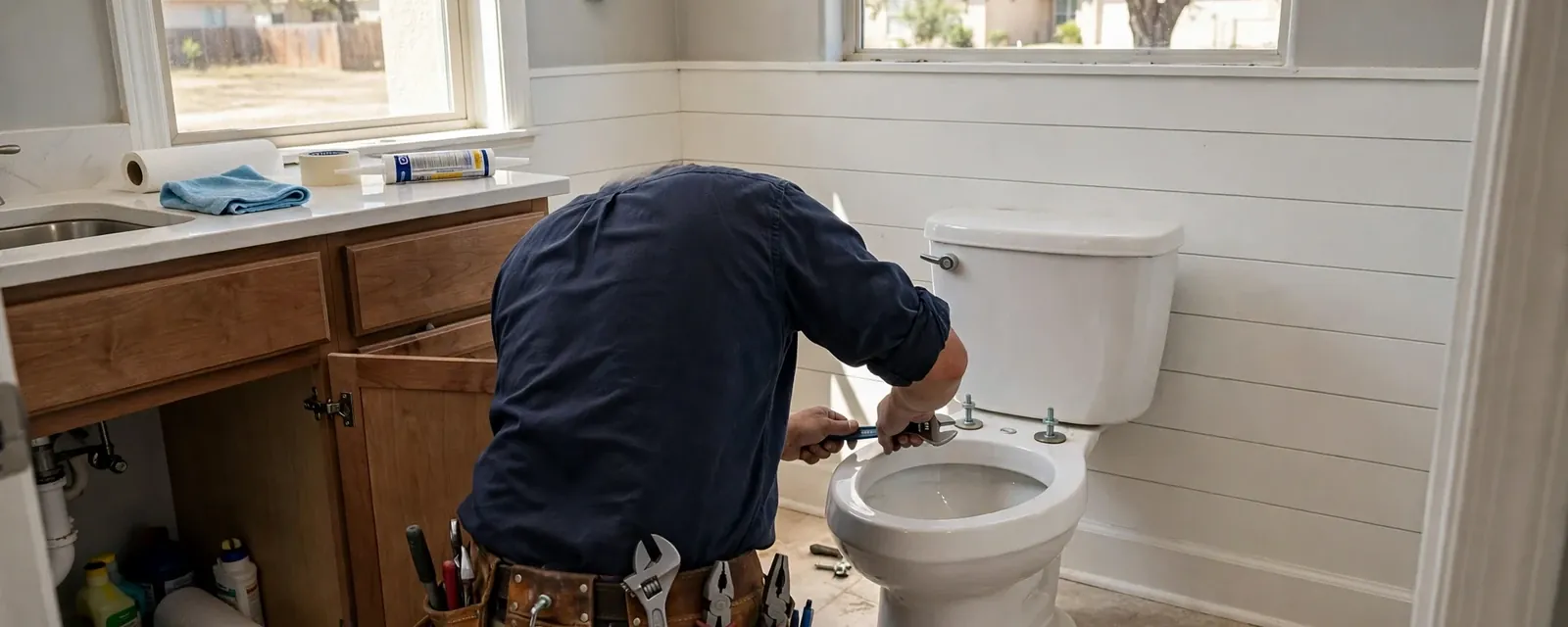
A toilet that overflows or leaks onto the floor cannot wait for a convenient weekday. Blue Island toilet repair starts with one call to our 24/7 emergency line, and licensed plumbers can book same-day appointments when available for problems that are annoying but not flooding. Call (773) 207-0518 and tell us what the bowl is doing, where the water is going, and whether a second drain in the house is also slow.
Most toilet problems come from four small parts: the flapper, the fill valve, the wax seal and the flange. Each one fails in its own way, and each one has a different fix. Knowing which one you have saves a visit that ends with the wrong part in the truck.
Toilet overflowing or leaking right now? Do these things first
Stay calm and stop the water before you reach for a plunger. Lift the tank lid, push the flapper down onto its seat, and turn the small oval valve on the wall or floor behind the bowl clockwise until it stops. That shutoff valve cuts the supply to this toilet only, so the rest of the house keeps running water.
- Close the valve behind the toilet. If it will not turn, shut the main water valve where the line enters the house, often in a basement or utility closet.
- Do not flush again, and do not run the sink, tub or washer on the same bathroom line until a plumber looks at it.
- Keep everyone away from wet floors near outlets, power strips and bathroom heaters. Switch off the breaker if water has reached an outlet.
- Lay towels around the base and move rugs and cabinet contents out of the wet zone.
- If water is also bubbling from a floor drain or tub, the problem is deeper than the toilet. Say so when you call (773) 207-0518.
Overnight and weekend calls get the same priority as weekday ones. Our emergency line is open around the clock for overflows and leaks that are damaging ceilings below.
Signs your toilet needs a plumber, not another flush
Callers describe the same handful of symptoms over and over. Match yours to the list, then tell the dispatcher what you see.
- The bowl gurgles after a flush. Air is being pulled through a partly blocked line, so check whether the tub or a nearby sink also drains slowly.
- Water pools around the base. A failed wax seal or cracked flange lets water out every time you flush, and it soaks the subfloor.
- The toilet rocks or shifts. Loose closet bolts or a flange that has pulled away from the floor will break the seal again if you only tighten the bolts.
- The tank refills for no reason. A worn flapper leaks into the bowl, and the fill valve restarts every few minutes.
- Two toilets will not flush. When more than one fixture backs up, the blockage is usually in the branch or main drain, so see sewer line cleaning.
Water on the bathroom floor?
Shut the valve behind the bowl, then call (773) 207-0518. A licensed plumber can walk you through it while we get a visit lined up.
Repair the toilet or replace it? A quick decision table
A toilet is a long-lived fixture, so repair is often the right call. Replacement makes sense when the porcelain itself is failing or when repeat repairs cost more than a new unit.
| Problem | Usual fix | Replace the toilet when |
|---|---|---|
| Running tank | New flapper or fill valve | The tank has hairline cracks or the trim is badly corroded |
| Leak at the base | New wax or foam seal, reset the bowl | The flange is rotted and the floor under it is soft |
| Rocking bowl | Shim, new bolts, or repair the flange | The bowl is cracked at the foot |
| Weak flush | Clean rim jets and the trapway | The bowl is stained and clogs often even when the drain is clear |
| Constant clogs | Snake the toilet, then the branch line | Clogs return after the drain tests clear |
How a toilet repair visit works
We keep the process simple so you know what is happening in your bathroom.
Find the source
The plumber checks the tank parts, the supply line, the shutoff valve and the base before touching anything, because a base leak can start at any of the three.
Pull the toilet if needed
For seal and flange work, the bowl comes off the floor, the old wax is scraped clean and the flange is inspected for cracks, rust and height.
Repair or replace the failed part
That may be a flange repair ring, a new seal, a fill valve, a flapper or a stainless supply line, set with new closet bolts.
Reset and test
The bowl is set level, bolted evenly, flushed several times and checked for weeping around the base and at every connection.
You get the price before the work starts. If the floor under a failed seal is damaged, we show you and explain what that changes.
Why older Blue Island bathrooms have flange trouble
About 64.7% of Blue Island housing was built before 1970, and the median home dates to 1961. Bathrooms that old have often been re-floored at least once, and a flange can end up sitting slightly low after new flooring goes down. A flange below the finished floor is one reason a new seal never holds.
Roughly 48% of Blue Island households rent, and about 41% of homes sit in buildings with two or more units. If you rent, a leak at the base can drip into the unit below, so report it to your landlord and call us quickly so the damage stays in one apartment.
The federal standard for toilets is 1.6 gallons per flush, and EPA WaterSense models use 1.28 or less. If an old toilet needs replacing rather than repair, a WaterSense model can cut water use. Plumbing work for hire in Illinois falls under the Illinois Plumbing License Law (225 ILCS 320).
New toilet installation: what to settle before the visit
Swapping a toilet looks simple until the old one comes up and the flange is rotted. A little planning avoids a second trip.
Bowl shape and height
Round bowls save space in tight rooms. Elongated bowls and comfort-height seats suit most adults.
Flush type
Single-flush and dual-flush models both work. Look for a WaterSense label if you want a water-saving model.
Old fittings
We check the flange, the shutoff valve and the supply line and replace whatever looks tired while the bowl is off.
Old toilet removal
Tell us if you want the old bowl hauled away. A porcelain toilet is heavy and awkward for one person to carry down a stairwell.
What moves the price of toilet repair
A fill valve swap is a small job. A flange repair with floor work is a bigger one. We give you a clear price before work starts, and we do not guess over the phone about what is behind the wall.
On insurance: sudden damage, such as a supply line that bursts and floods a floor, is the usual covered case. A slow seep, long-term wear or a sewer backup often needs a specific endorsement, so read your policy or ask your agent. Want your real number? Call (773) 207-0518.
Toilet repair questions from Blue Island homes
Yes. The emergency line is staffed 24/7, including nights, weekends and holidays. An overflow that is soaking a ceiling or a leak near live wiring goes to the front of the line.
For slow leaks and running tanks, we can often book a same-day appointment when available.
It is better not to. Each flush pushes water past a failed seal and into the subfloor, where it rots wood and can stain the ceiling below.
Close the valve behind the bowl and call. A replacement seal is a small job compared with floor repair.
Usually the flapper is letting tank water slip into the bowl. The fill valve then tops the tank up again, and you hear it every few minutes.
It is a small repair, but a running toilet can add real water to a monthly bill, since Blue Island bills water monthly.
Blue Island code section 150.052 requires permits for plumbing installation and repair. The city's Building Safety Department at City Hall can tell you how it treats a fixture swap, so ask them before you assume either way.
Search the Illinois Department of Public Health plumbing license lookup. Our plumbers are licensed and insured, and you can ask to see a license before any work begins.
That points to the branch or main drain, not a single bowl. Stop using water, and call. We would look at the drain line first and the toilet second.