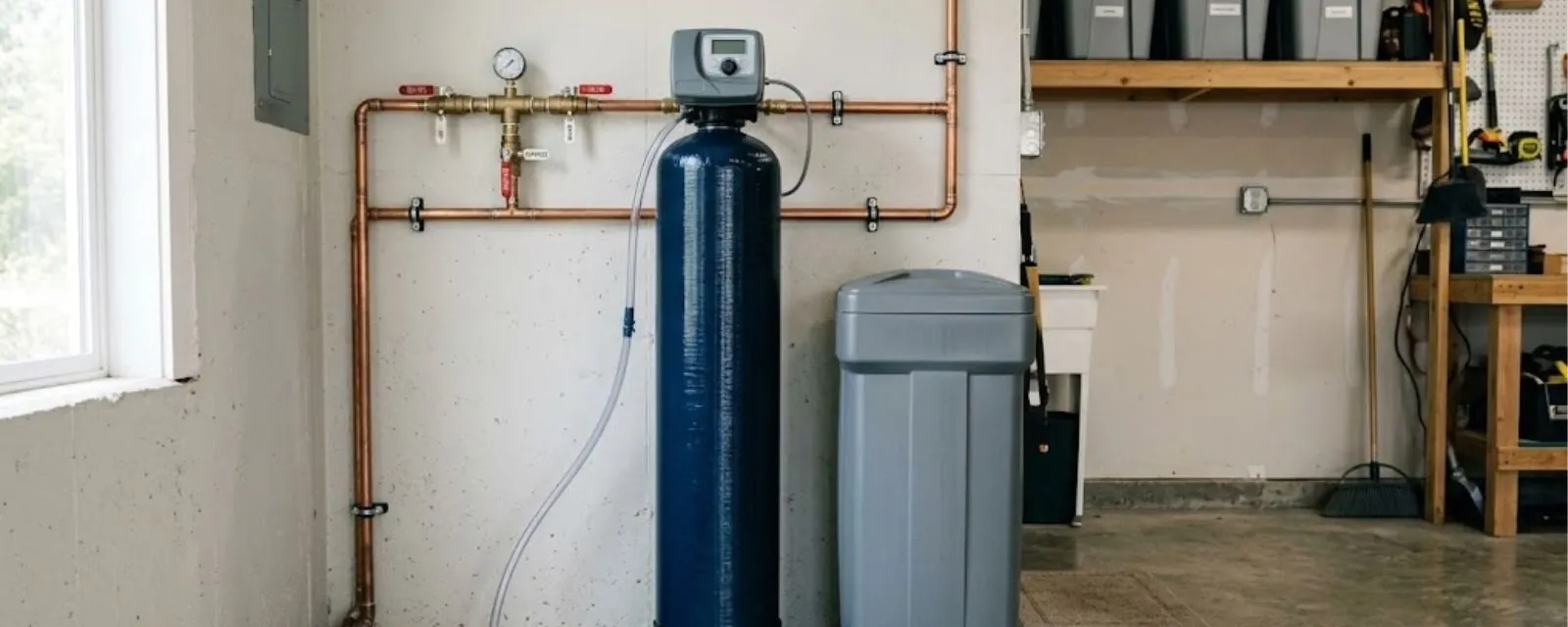
Buying a water softener before you know your water is the most common mistake we hear about. Chalky glassware, spotted fixtures and scale in the kettle suggest hard water, but a test tells you how hard. Blue Island buys its water from Chicago, so the water quality report from the city is the right first stop.
Once you know what you are treating, our licensed plumbers handle the plumbing side: installing a softener or filter, repairing a leaking valve, and replacing an old unit. This is planned work, and you can book a same-day appointment when available by calling (773) 207-0518.
Test your tap before you choose equipment
We have not verified a hardness figure for Blue Island, so we will not guess one. Here is how to get your own number.
Ask the utility
Call the Blue Island Water and Sewer Department at City Hall, 13051 Greenwood Avenue, and ask whether the annual water quality report lists hardness.
Test at home
Use a test strip kit or a lab test from a certified laboratory, drawn from a cold tap that has not been softened.
Read the units
Hardness is reported as grains per gallon or milligrams per liter. Mixing them up leads to oversized equipment.
Match the equipment
A softener removes scale-forming minerals. A filter targets other things, such as taste or particles. Many homes need only one.
What the 2025 Blue Island water report says, and what it does not
Blue Island's 2025 Consumer Confidence Report shows water that comes from Lake Michigan, treated at Chicago's Jardine and Sawyer plants. The city states it met or exceeded all drinking water standards. The report lists a highest fluoride reading of 0.75 ppm and sodium up to 9.10 ppm, but we could not find a hardness figure in it.
That sodium number matters if you are considering a softener. Softening exchanges hardness minerals for sodium or potassium, so ask your doctor if you are on a low-sodium diet. Never treat the report as a hardness test.
Questions about your water?
Call (773) 207-0518 to talk with a licensed plumber about testing, softeners and filters.
Softener, filter, or both
The right choice depends on the problem you are trying to solve.
| What you notice | Likely tool | What to confirm first |
|---|---|---|
| White scale on faucets, spotty dishes | Water softener | A hardness test result |
| Chlorine taste or smell | Carbon filter | Whether you mean the whole house or one tap |
| Particles or sediment | Sediment filter | Whether the source is the city main or your own pipes |
| Concern about lead in older pipes | Filter certified for lead reduction | Your service line material (see below) |
| Scale plus taste complaints | Softener plus filter | Space, drain access and a power outlet |
A filter makes no claim about hardness, and a softener makes no claim about lead. Buying the wrong one is easy, which is why we start with the test.
Older pipes and lead: a different question from hardness
Blue Island's service line inventory, dated April 1, 2025, lists 5,433 total lines. Of those, 529 are lead, 81 are galvanized and need replacement, and 4,707 are still unknown. In August 2026 the city offered free in-home service line identification, and you can ask the Water and Sewer Department whether it is still available.
A softener does not remove lead. If you learn your line is lead, a plumber can discuss replacement and the city can advise on testing. Until then, ask about a filter independently certified for lead reduction. Our repiping and water line repair pages cover work on the pipes themselves.
What we install and repair
Our work covers the plumbing connections and the common failure points.
Softener installation
Bypass valve, hard-water supply, drain line for the brine discharge and a nearby outlet for the control head.
Filter installation
Whole-house or under-sink housings, with a shutoff and a pressure gauge where it makes sense.
Valve and head repair
Broken or leaking valves, cracked fittings and damaged lines, including those hit during moves or construction.
Replacement
We disconnect the old tank, size the new one and test for leaks.
Problems we hear about softener systems
These are the situations that prompt people to call.
- Salt level does not drop. The unit may not be regenerating or the brine tank may have a bridge.
- Water is still hard. The resin may be spent, the bypass may be open or the control head may be stuck.
- Leaking at the valve. Damage from a move or construction sometimes cracks a tank or fitting.
- Brine drain overflow. A kinked drain line or a clogged air gap can send water to the floor.
- Odd noises during regeneration. That can be normal, but constant running is not.
What changes the price of a softener or filter job
We give you a clear price before work starts. The equipment and the room set most of the cost.
Insurance seldom covers water treatment equipment, and sudden burst damage is the usual covered case. Gradual leaks and wear often are not, so check your policy. Want your real number? Call (773) 207-0518.
Where the equipment goes in a Blue Island home
Most softeners go in the basement near the main shutoff and a floor drain. The City of Blue Island's code requires each main building to have its own water service pipe, tap, meter and a shutoff ahead of the meter, which is where your main line enters.
Permit questions go to the Building Safety Department at City Hall, which can say whether a softener hookup needs one. For fixtures that need work alongside the softener, see faucet repair.
Installing a softener or filter ties into your supply piping, so it is plumbing work under the Illinois Plumbing License Law (225 ILCS 320) and the Illinois Plumbing Code, 77 Ill. Adm. Code 890. Ask any installer to show a current state licence, and check it against the Illinois Department of Public Health licence lookup before signing.
If you already own a softener or conditioner that has stopped working, the usual repair calls are a stuck or noisy control head, a brine tank that never draws, a drain line that has kinked or frozen, and a resin tank that no longer softens. Describe which one you see when you call (773) 207-0518, because the fix for a bad control valve is very different from the fix for exhausted resin.
Softener and filter questions for Blue Island homes
We cannot state a hardness figure because the city's 2025 report does not list one. Test your tap or ask the Blue Island Water and Sewer Department for the figure.
Blue Island buys water from the City of Chicago, which draws from Lake Michigan and treats it at the Jardine and Sawyer plants.
No. A softener addresses hardness minerals. For lead, find out your service line material and ask about a filter certified for lead reduction.
Yes, most plumbing-side repairs such as valves, fittings, drain lines and bypass assemblies. If the control head has an electronic fault, the maker may need to supply the part.
Softened water can reduce scale buildup, but the benefit depends on how hard your water was. A test gives the answer.
Check the Illinois Department of Public Health plumbing license verification page before the visit.